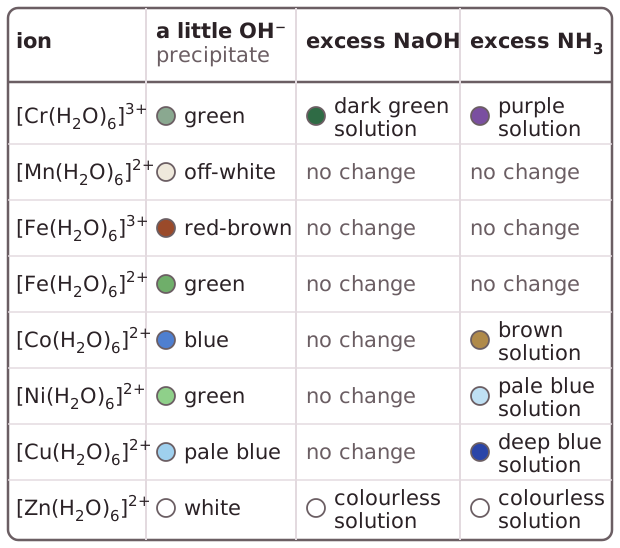
Deprotonation is a reaction in which a base removes a proton from a species. Hexaaqua (II) ions react with water, a weak base, to release H+ ions. The reaction is reversible and the equilibrium is to the left, so the solution with water is weakly acidic as [M(OH)(H2O)5]+ ions are formed along with H3O+ ions.[M(H2O)6]2+ + H2O ⇌ [M(OH)(H2O)5]+ + H3O+When the equilibrium is disturbed by adding OH- ions which reacts with the H+ ions, the position of equilibrium moves to the right and further deprotonation occurs to form a neutral [M(OH)2(H2O)4] complex. Some metal ions e.g. chromium form amphoteric hydroxides which dissolve in excess NaOH to form e.g. [Cr(OH)6]3- ions.