An amino acid contains both an amine group, -NH2, and a carboxylic acid group, -COOH. The amino acids found in proteins are α-amino acids: both groups are attached to the same carbon atom. Their general formula is:RCH(NH2)COOH 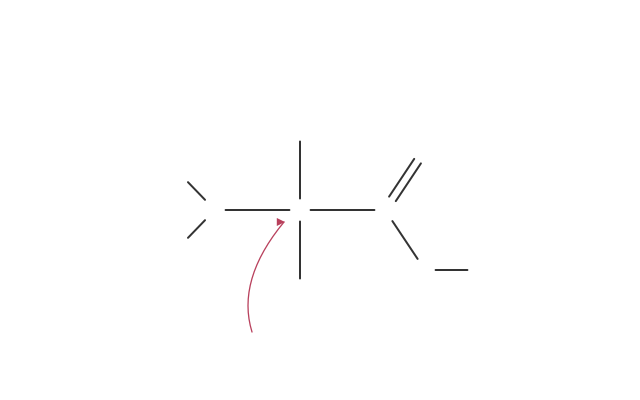
• glycine: R = H
• alanine: R = CH3
• serine: R = CH2OH
• cysteine: R = CH2SH
Side chains can be non-polar, polar, acidic (with an extra -COOH) or basic (with an extra -NH2).Naming. Amino acids have common names, but you should be able to give IUPAC names. The COOH carbon is C1. Alanine, CH3CH(NH2)COOH, is 2-aminopropanoic acid; glycine is aminoethanoic acid.Chirality. In every amino acid except glycine, the central carbon is bonded to four different groups (H, NH2, COOH and R). It is a chiral centre, so the amino acid exists as two optical isomers (enantiomers). Glycine has two H atoms on this carbon, so it is not chiral.Worked example. Name valine, (CH3)2CHCH(NH2)COOH. The longest chain including the COOH carbon has four carbons, with NH2 on C2 and a methyl group on C3: 2-amino-3-methylbutanoic acid.