Aldehydes and ketones react by nucleophilic addition. The C=O bond is polar: the carbon is δ+ and the oxygen is δ−. A nucleophile (an electron pair donor) is attracted to the δ+ carbon, and two species join to make one product, so it is an addition.The mechanism, using NaBH4 (nucleophile H−):
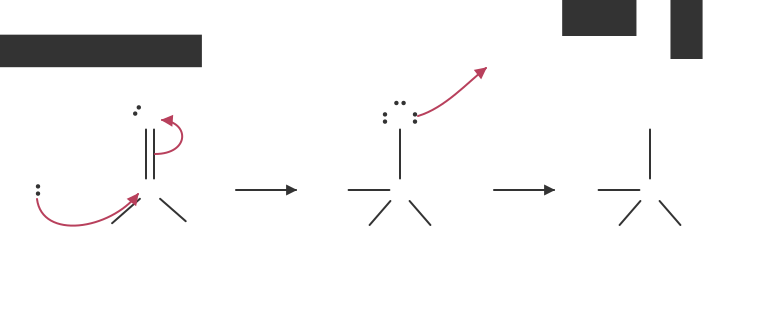
Step 1. A curly arrow goes from the lone pair on the hydride ion, :H−, to the δ+ carbonyl carbon. At the same time, a curly arrow goes from the C=O double bond to the oxygen atom: the π bond breaks and its electrons move onto the oxygen. This gives a negatively charged intermediate with O− (an alkoxide ion).Step 2. A curly arrow goes from a lone pair on the O− to an H+ ion (from water or dilute acid). The oxygen is protonated and the alcohol forms.Getting the marks: show the δ+ and δ− on C=O, start the first arrow from the lone pair (or negative charge) on the nucleophile, show the arrow from the C=O bond to O, draw the intermediate with its negative charge on oxygen, and start the last arrow from a lone pair on O−.The same mechanism works with the cyanide ion, :CN−, as the nucleophile, which the next lesson covers.Example: H− adds to propanone, CH3COCH3, giving the intermediate CH3CH(O−)CH3, which is protonated to give propan-2-ol, CH3CH(OH)CH3.
Nucleophilic Addition Mechanism
Read the text
Read the text and highlight anything you think is important. When you go on, the text is hidden and you answer from memory.
Specification: AQA Chemistry (7405), A-level, 3.3.8 Aldehydes and ketones. Topic: Aldehydes and Ketones.
More in Aldehydes and Ketones
- Aldehydes and Ketones
- Naming Carbonyl Compounds
- Oxidation of Aldehydes
- Tollens' Reagent
- Fehling's Solution
- Reduction with NaBH4
- Reaction with KCN and Hydroxynitriles
- Hazards of KCN
All 9 lessons in Aldehydes and Ketones · All AQA A-level Chemistry topics