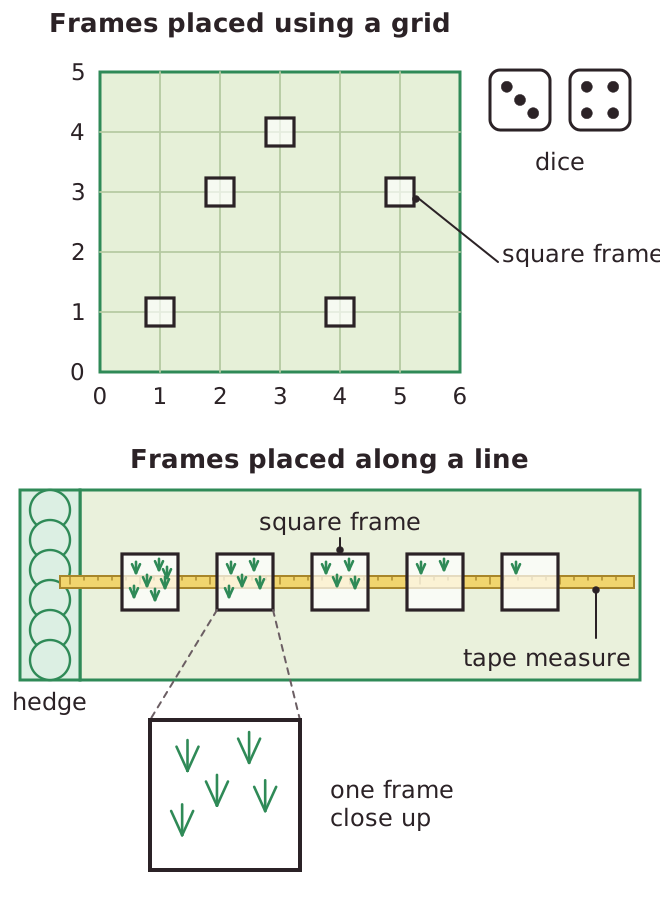
A field investigation finds out where organisms live (their distribution) and how many there are (their abundance). It is not possible to count every organism in a habitat, so you take samples. A quadrat is a square frame, often 1 m by 1 m, that you place on the ground and count the organisms inside. A pooter sucks up small insects so they can be counted, a net is swept through long grass or a pond, and a key uses features such as leaf shape to identify unknown species.
To avoid bias, quadrats are placed at random positions. You can lay a grid over the area and use random numbers as the coordinates, so the results are not biased by where you choose to look. A larger number of quadrats gives a more reliable mean. A transect is a line, such as a tape measure, laid across a habitat where conditions change, for example from a hedge into an open field. Quadrats are placed at regular intervals along the line, which shows how distribution changes along the transect.
To scale up, find the mean number per quadrat, then multiply it by the total area divided by the quadrat area. A mean of 4 plants in each 1 m2 quadrat in a 500 m2 field gives 4 × 500 = 2000 plants. Animals that move around can be estimated by capture-recapture. A first sample is caught, marked harmlessly and released. After they have mixed back in, a second sample is caught and the marked ones are counted. Population = (first sample × second sample) ÷ number marked in the second sample. If 30 are marked, and a second sample of 40 contains 10 marked, the estimate is 30 × 40 ÷ 10 = 120.