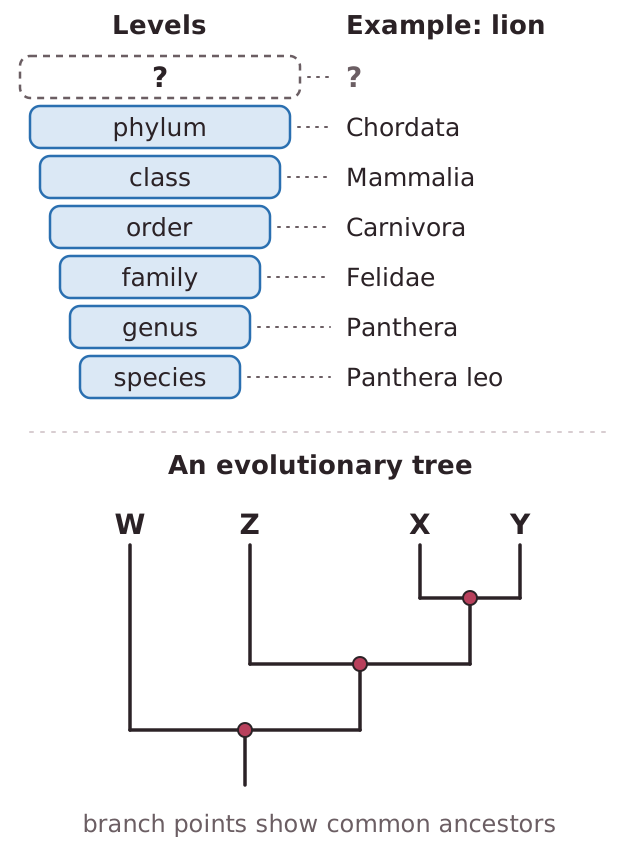
Scientists sort living things into groups to make them easier to study. In an artificial classification, organisms are grouped using a few chosen features, such as whether they fly or live in water. This is convenient, but it can put distantly related organisms together, for example bats and birds, and it does not show how organisms are related.
A natural classification groups organisms using many shared features, so that those placed together are more closely related. The Linnaean system is a natural system. It sorts organisms into kingdom, phylum, class, order, family, genus and species, with each group nested inside the one above.
Developments in biology have changed classification. Better microscopes revealed cell structures, and biochemistry showed which organisms share similar proteins. Now molecular phylogenetics compares the sequence of bases in the DNA of different species. The more similar the DNA sequences, the more closely related the species and the more recently they shared a common ancestor. This has led to new groupings, such as placing organisms into three domains, called Archaea, Bacteria and Eukaryota, and the results are shown as evolutionary trees.