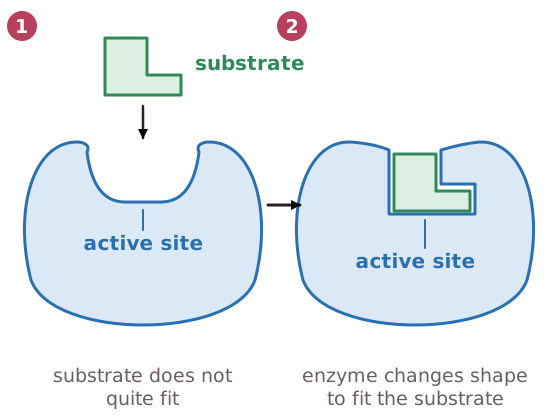
Enzymes are soluble proteins that are dissolved in aqueous environments in the body.Molecules in solution move and collide randomly. The higher the temperature of the molecules, the more kinetic energy they have and the faster the molecules move.The greater kinetic energy means they collide more often (more collisions per unit time) and with greater energy.If the molecules are in the correct orientation a reaction will occur if they have sufficient energy to break the existing bonds. This energy is called the activation energy.Enzymes reduce the activation energy needed for reactions so that reactions which would not happen at an appreciable rate at normal temperatures will be able to proceed quickly. Enzymes are biological catalysts that increase the rate of reaction by helping molecules collide successfully.There are thousands of enzymes. One for each substrate. Enzymes are said to be specific as each catalyses only one biochemical reaction.In the induced-fit model, the proximity of the substrate leads to a change in the shape of the enzyme, which moulds itself around the substrate so that the active site becomes complementary to it. The enzyme puts a strain on the bonds of the substrate, weakening critical bonds and stabilising the transition state, which lowers the activation energy.