Skip to content

Student T-test

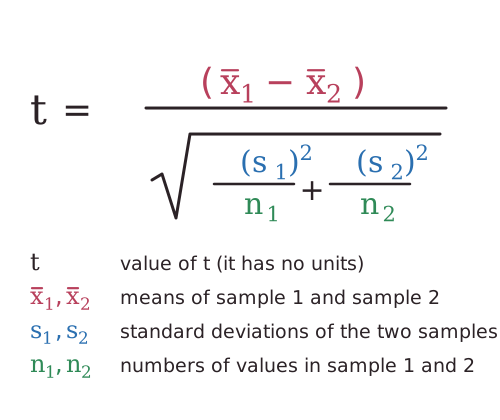
The student t-test is used to compare the means of data values of two populations.The sample sizes may be different, but the data must be normally distributed and the sample size must be large enough to be reliable.A null hypothesis is stated predicting there is no significant difference between the means and that any observed difference is due to chance alone. The alternative hypothesis is that there is a significant difference between the means and the difference is not due to chance.The students t-test then determines if there is a statistical difference between the means.For the data to be considered significantly different from chance alone the probability of the value obtained are different must be 5% or less.This means that we have to be 95% confident that the difference is not due to chance.The formula for the students t-test is:
Read the text

Read the text and highlight anything you think is important. When you go on, the text is hidden and you answer from memory.

Specification: OCR Biology A (H020), AS-level, 4.2.2 Classification and evolution. Topic: Classification and Evolution.

Key terms in this lesson

pathogen
A microorganism that causes disease.
antigen
A molecule, usually a protein, on the surface of a cell or pathogen that triggers an immune response.
antibody
A Y-shaped protein (immunoglobulin) produced by B plasma cells that binds specifically to a particular antigen.
opsonin
A protein, such as an antibody, that binds to a pathogen and tags it so that it is more easily recognised and engulfed by phagocytes.

More in Classification and Evolution

All 36 lessons in Classification and Evolution · All OCR AS-level Biology topics