Phylogenetic classification is based on evolutionary relationships between organisms and their ancestors and homologous characteristics which have similar genetic origins e.g. the wing of the bird and the arm of a human.A homologous structure may appear superficially different and may even perform a different function but it has the same underlying structure.For example, the pentadactyl limb bone structure is observed in the arms of primates, front legs of horses, in the wings of bats, and the flippers of seals.The presence of homologous structures is evidence of divergent evolution.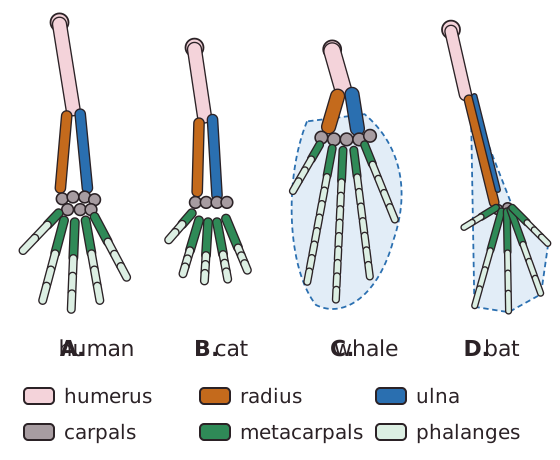
A. human B. cat C. whale D. bat
A. human B. cat C. whale D. bat