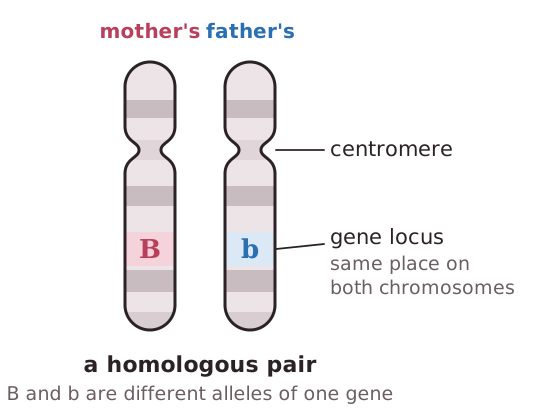
Mutations are changes to the DNA base sequence that result in changes to the amino-acid sequence of proteins.This may lead to different phenotypes. If a mutation occurs in the gametes it may be passed to the offspring.As a result of mutations, there are different versions of the same genes, called allelesDuring fertilisation one allele is inherited from each parent. The combination of alleles (the genotype) determines the phenotype or observable characteristics of the individual and the environment modifies these characteristics.Dominant alleles are always expressed even when the individual has different alleles (heterozygous) whereas a recessive allele is only expressed if there are two copies (homozygous). 
Genetic Causes of Variation - Mutation
Read the text
Read the text and highlight anything you think is important. When you go on, the text is hidden and you answer from memory.
Specification: OCR Biology A (H020), AS-level, 4.2.2 Classification and evolution. Topic: Classification and Evolution.
Key terms in this lesson
- phagocytosis
- The process by which a cell, such as a white blood cell, engulfs and digests a pathogen or debris.
- hydrostatic pressure
- The pressure exerted by a fluid, such as blood, that forces fluid out of the capillaries to form tissue fluid.
- pathogen
- A microorganism that causes disease.
More in Classification and Evolution
- Palaeontology
- Comparative Anatomy
- Comparative Biochemistry
- Types of Variation
- Genetic Causes of Variation - Meiosis and Chance
- Environmental Causes of Variation
- Discontinuous Variation
- Continuous Variation
All 36 lessons in Classification and Evolution · All OCR AS-level Biology topics