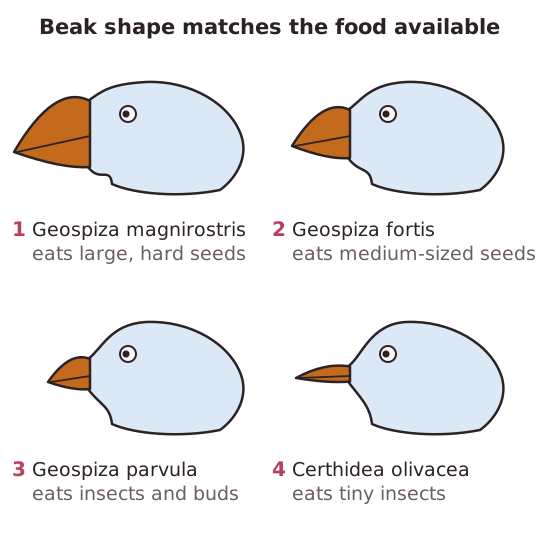
Evolution is a theory that describes the way in which organisms change over time as a result of natural selection.Organisms best suited to their environment are more likely to survive and reproduce, passing their characteristic to their offspring. Gradually species change over time to have a more advantageous genotypes for the environment in which it lives.Darwin studied finches of the Galapagos islands. Different islands had finches with beaks and claws of different shapes and sizes.The design of the beaks was correlated with the food available on each island.At around the same time as Darwin, Alfred Wallace was working on a similar theory and sent his ideas to Darwin in 1858 for peer review before publication.In 1859 Darwin published the Origin of Species, a book that was very controversial at the time.
Theory of Evolution
Read the text
Read the text and highlight anything you think is important. When you go on, the text is hidden and you answer from memory.
Specification: OCR Biology A (H020), AS-level, 4.2.2 Classification and evolution. Topic: Classification and Evolution.
Key terms in this lesson
- pathogen
- A microorganism that causes disease.
- vector
- An organism, such as an insect, that transmits a pathogen from one host to another.
- antigen
- A molecule, usually a protein, on the surface of a cell or pathogen that triggers an immune response.
- antibody
- A Y-shaped protein (immunoglobulin) produced by B plasma cells that binds specifically to a particular antigen.
More in Classification and Evolution
- The Three Domain System
- Archaebacteria and Eubacteria
- Phylogeny
- Advantages of Phylogenetic Classification
- Evidence for Evolution
- Palaeontology
- Comparative Anatomy
- Comparative Biochemistry
All 36 lessons in Classification and Evolution · All OCR AS-level Biology topics