Blood is a tissue made of cells suspended in a liquid. If a blood sample is spun in a centrifuge, it separates into layers:• plasma, the pale yellow liquid at the top, about 55% of the blood volume
• a thin pale layer, the buffy coat, containing white blood cells and platelets
• red blood cells at the bottom, about 45% of the blood volume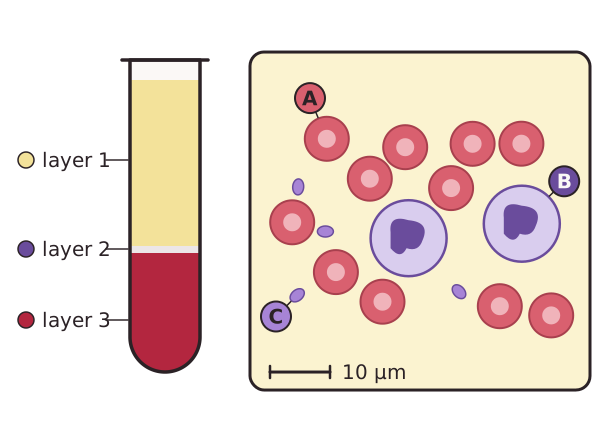 The main components and their roles are:• Plasma: mostly water; transports dissolved substances such as glucose, amino acids, ions, hormones, urea, carbon dioxide and plasma proteins, and distributes heat.
• Erythrocytes (red blood cells): the most numerous cells; contain haemoglobin and transport oxygen, and help carry carbon dioxide.
• Leucocytes (white blood cells): larger and much less numerous than red cells; have a nucleus; defend the body against pathogens by phagocytosis and the immune response.
• Platelets: small fragments of cells with no nucleus; involved in blood clotting.In a typical mm3 of human blood there are about 5 million erythrocytes, 4000 to 11 000 leucocytes and 150 000 to 400 000 platelets.All blood cells are made from stem cells in the bone marrow.Blood also carries out other functions because of these components: it helps maintain pH (plasma proteins and hydrogencarbonate act as buffers), it maintains water potential, and clotting seals wounds to limit blood loss and entry of pathogens. Each component is looked at in detail in the following lessons.
• a thin pale layer, the buffy coat, containing white blood cells and platelets
• red blood cells at the bottom, about 45% of the blood volume
The main components and their roles are:• Plasma: mostly water; transports dissolved substances such as glucose, amino acids, ions, hormones, urea, carbon dioxide and plasma proteins, and distributes heat.• Erythrocytes (red blood cells): the most numerous cells; contain haemoglobin and transport oxygen, and help carry carbon dioxide.
• Leucocytes (white blood cells): larger and much less numerous than red cells; have a nucleus; defend the body against pathogens by phagocytosis and the immune response.
• Platelets: small fragments of cells with no nucleus; involved in blood clotting.In a typical mm3 of human blood there are about 5 million erythrocytes, 4000 to 11 000 leucocytes and 150 000 to 400 000 platelets.All blood cells are made from stem cells in the bone marrow.Blood also carries out other functions because of these components: it helps maintain pH (plasma proteins and hydrogencarbonate act as buffers), it maintains water potential, and clotting seals wounds to limit blood loss and entry of pathogens. Each component is looked at in detail in the following lessons.