Granulocytes are leucocytes with a granular cytoplasm and a lobed nucleus. The granules are mostly lysosomes and vesicles containing enzymes and other chemicals. Granulocytes make up about 70% of all leucocytes. There are three types, named after how their granules stain.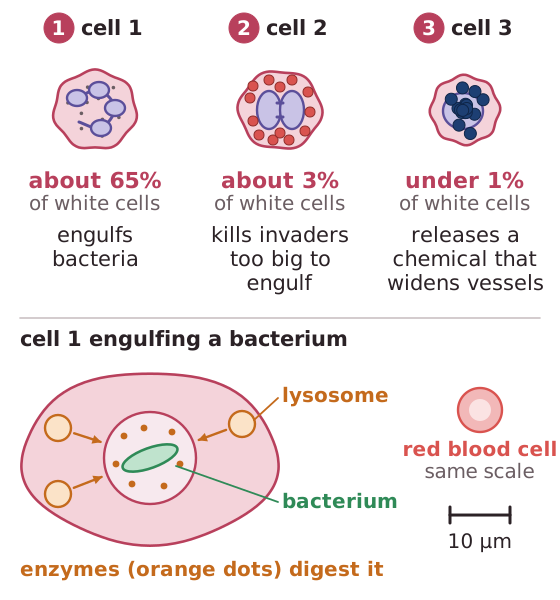 Neutrophils
• the most common leucocyte, about 60 to 70% of all white cells
• nucleus has several lobes (usually three to five)
• phagocytes: they are attracted to sites of infection, squeeze out of capillaries, engulf bacteria and digest them with enzymes from their lysosomes
• usually the first cells to arrive at an infection; they are short-lived, and dead neutrophils form much of the pus in an infected woundEosinophils
• about 1 to 4% of leucocytes
• nucleus usually has two lobes, and the granules stain red with the dye eosin
• help to destroy parasites such as worms that are too big to engulf, by releasing toxic chemicals
• numbers increase during allergic reactionsBasophils
• the least common, below 1% of leucocytes
• nucleus lobed but often hidden by large granules that stain dark blue
• release histamine, which causes inflammation by widening blood vessels and making capillaries leakier, and heparin, which prevents clotting
• involved in inflammation and allergic responsesGranulocytes are part of the non-specific defence: they respond to any pathogen in the same way, rather than to one particular antigen.
Neutrophils• the most common leucocyte, about 60 to 70% of all white cells
• nucleus has several lobes (usually three to five)
• phagocytes: they are attracted to sites of infection, squeeze out of capillaries, engulf bacteria and digest them with enzymes from their lysosomes
• usually the first cells to arrive at an infection; they are short-lived, and dead neutrophils form much of the pus in an infected woundEosinophils
• about 1 to 4% of leucocytes
• nucleus usually has two lobes, and the granules stain red with the dye eosin
• help to destroy parasites such as worms that are too big to engulf, by releasing toxic chemicals
• numbers increase during allergic reactionsBasophils
• the least common, below 1% of leucocytes
• nucleus lobed but often hidden by large granules that stain dark blue
• release histamine, which causes inflammation by widening blood vessels and making capillaries leakier, and heparin, which prevents clotting
• involved in inflammation and allergic responsesGranulocytes are part of the non-specific defence: they respond to any pathogen in the same way, rather than to one particular antigen.