Animals with a circulatory system use one of two basic designs: an open or a closed circulation.Open circulatory system
The blood is not kept inside vessels for its whole journey. In insects, a long tube-shaped heart along the back pumps blood (called haemolymph) forward and out into the body cavity, the haemocoel. Here the blood bathes the tissues directly and substances are exchanged by diffusion. The blood then drifts slowly back to the heart through openings called ostia.• blood is at low pressure and flows slowly
• there is little control over where blood goes
• this is adequate for insects because their oxygen is delivered by the tracheal system, not by the bloodClosed circulatory system
The blood stays inside a continuous network of vessels all the time. It is pumped by a heart through arteries to capillaries, where substances are exchanged with the tissue fluid around cells, and returns through veins. Closed systems are found in vertebrates, such as fish and mammals, and in some invertebrates, such as earthworms.• blood is at higher pressure and flows faster
• blood flow can be directed to the tissues that need it most, by narrowing or widening vessels
• the rapid delivery of oxygen and nutrients supports larger, more active animals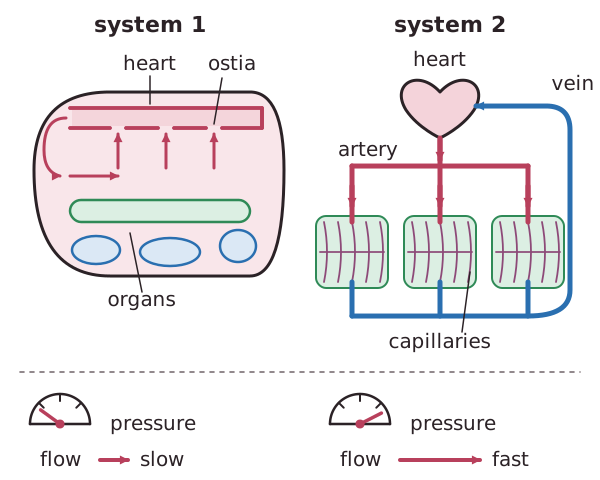 Closed systems can be further divided into single and double circulations, covered in the next two lessons.
The blood is not kept inside vessels for its whole journey. In insects, a long tube-shaped heart along the back pumps blood (called haemolymph) forward and out into the body cavity, the haemocoel. Here the blood bathes the tissues directly and substances are exchanged by diffusion. The blood then drifts slowly back to the heart through openings called ostia.• blood is at low pressure and flows slowly
• there is little control over where blood goes
• this is adequate for insects because their oxygen is delivered by the tracheal system, not by the bloodClosed circulatory system
The blood stays inside a continuous network of vessels all the time. It is pumped by a heart through arteries to capillaries, where substances are exchanged with the tissue fluid around cells, and returns through veins. Closed systems are found in vertebrates, such as fish and mammals, and in some invertebrates, such as earthworms.• blood is at higher pressure and flows faster
• blood flow can be directed to the tissues that need it most, by narrowing or widening vessels
• the rapid delivery of oxygen and nutrients supports larger, more active animals
Closed systems can be further divided into single and double circulations, covered in the next two lessons.