 BRAINCAKE
Facilitated Diffusion
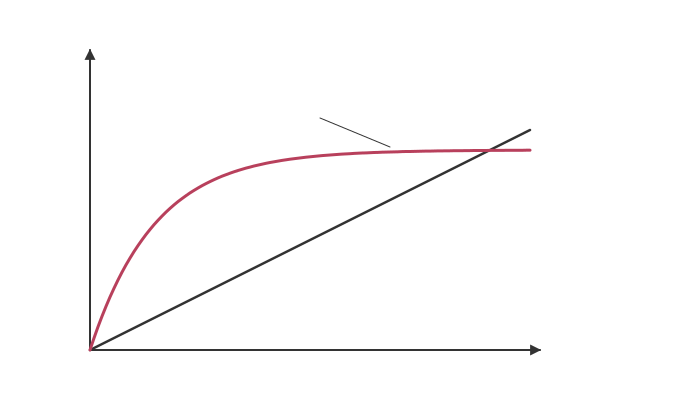
Facilitated diffusion is the passive movement of molecules or ions down their concentration gradient through specific membrane proteins. Like simple diffusion, it uses no ATP; the proteins simply provide a route through the hydrophobic core of the membrane.
It is used by ions and polar molecules, which cannot pass through the bilayer, for example sodium ions, chloride ions, glucose and amino acids. Two types of protein are involved:
Channel proteins form water-filled, hydrophilic pores. Each is specific to one ion or molecule. Many are gated: they open or close in response to a signal, such as a change in voltage across the membrane or the binding of a chemical. Aquaporins are channel proteins for water.
Sign in free to see the rest of this lesson, the R.E.C.I.P.E. recall steps and the quiz
BrainCake is free. Make an account in seconds and pick up where this page stops.
Key terms in this lesson
- concentration gradient
- The difference in the concentration of a substance between two regions, which determines the direction of net diffusion.
More in Cell Transport Mechanisms
- The Need for Transport
- Transport Across the Cell Membrane
- Passive and Active Transport
- Diffusion
- Water Potential ψ
- Osmosis
- Modelling Osmosis
- Osmotic Concentrations
All 18 lessons in Cell Transport Mechanisms · All Edexcel AS-level Biology topics