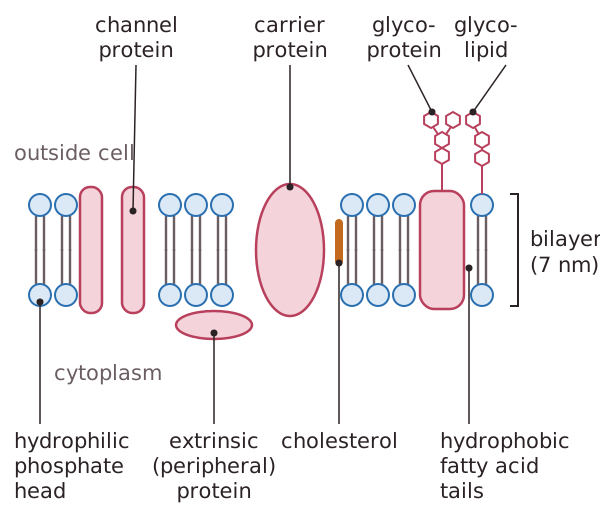
The arrangement of the components of the plasma membrane is known as the fluid mosaic model. The membrane is fluid and flexible. The phospholipid molecules can move relative to one another and the membrane can change its shape.The membrane has the appearance of a mosaic pattern. The proteins embedded in the membrane vary in shape, size and position.Phospholipid is the main component of plasma membrane.It provides selective permeability to the cell membrane.The phospholipid bilayer gives fluidity and elasticity to the membrane.The cell membrane has a two-dimensional liquid where embedded proteins are randomly distributed.Proteins are embedded within or on the surface of phospholipid layers.Proteins spanning the bilayer can form channels to allow the movement of polar molecules and ions in and out of the cell.Carbohydrates attached to proteins on outside membrane layer helps in cell-to-cell recognition and adhesion.Cholesterol between phospholipids and phospholipid helps the plasma membrane to retain its fluidity.