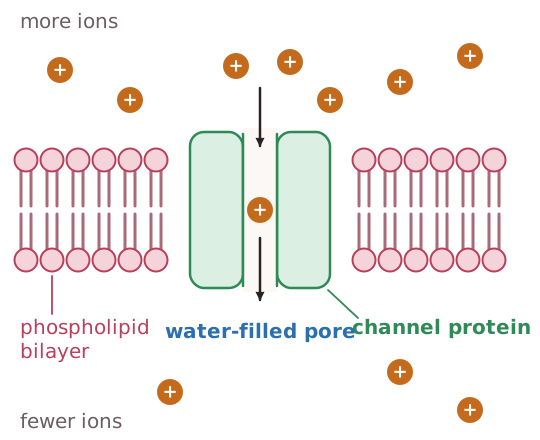
Channel proteins form water-filled pores across the bilayer through which specific solutes can diffuse.Small polar molecules and ions pass through the hydrophilic channels or pores formed by proteins that span the membrane. Each protein only allows the passage of one particular ion or molecule so is specific.Channel proteins interact with the solute to be transported only weakly. When these pores are open, they allow specific solutes (usually inorganic ions of appropriate size and charge) to pass through them and thereby cross the membrane unimpeded.Transport through channel proteins occurs at a much faster rate than transport mediated by carrier proteins.