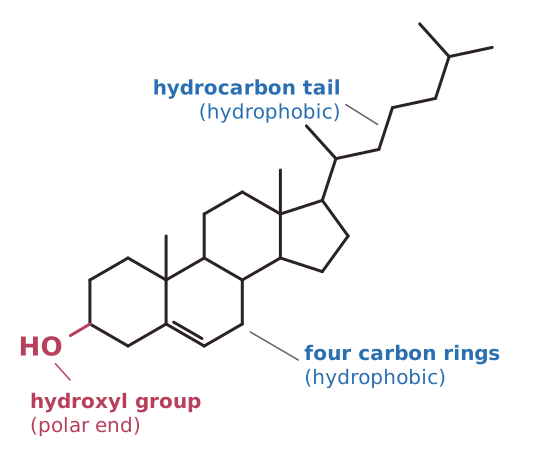
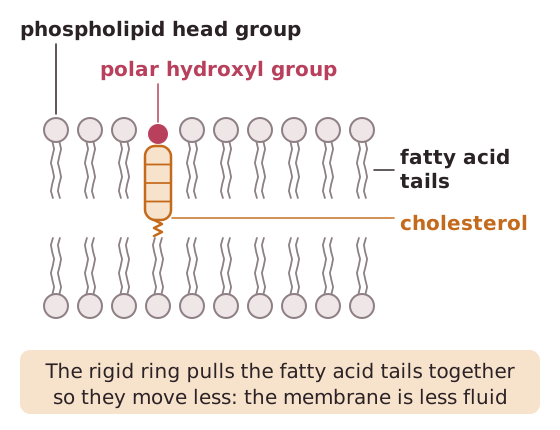
Cholesterol is a hydrophobic molecule that occurs within the membrane.It adds strength to the membrane, regulates the fluidity of the membrane and prevents the leakage of water and ions across the membrane.The cholesterol molecules pull the fatty acid chains together and limit their movement in the phospholipid bilayer.This makes the membrane less fluid, protects against disruption of the membrane at high temperatures and limits the lateral movement of molecules within the membrane.
Cholesterol
Read the text
Read the text and highlight anything you think is important. When you go on, the text is hidden and you answer from memory.
Specification: AQA Biology (7401), AS-level, 3.2.3 Transport across cell membranes. Topic: Transport Across Cell Membranes.
Key terms in this lesson
- phospholipid
- A lipid in which one fatty acid is replaced by a phosphate group, giving a hydrophilic head and hydrophobic tails.
More in Transport Across Cell Membranes
- Plasma Membrane
- Phospholipids
- Proteins
- Glycolipids
- Glycoproteins
- Fluid-mosaic Model
- Membrane Permeability
- Simple Diffusion
All 22 lessons in Transport Across Cell Membranes · All AQA AS-level Biology topics