 BRAINCAKE
Proteins
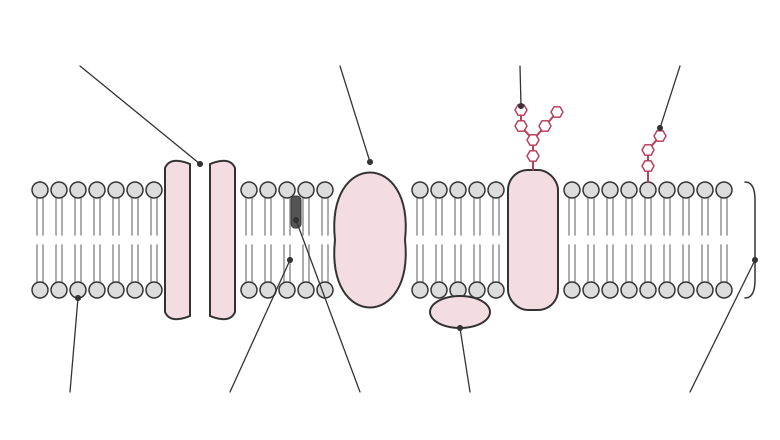
Many proteins are embedded in the phospholipid bilayer.
Channel proteins span the bilayer and form hydrophilic pores which are water-filled tubes to allow the diffusion of ions across the membrane.
Carrier proteins also span the bilayer. They bind to ions such as sodium and potassium ions and molecules such as glucose and amino-acids and change shape to allow these substances to diffuse across the membrane.
Sign in free to see the rest of this lesson, the R.E.C.I.P.E. recall steps and the quiz
BrainCake is free. Make an account in seconds and pick up where this page stops.
Key terms in this lesson
- hydrolysis
- The breaking of a covalent bond within a molecule using a water molecule.
- phospholipid
- A lipid in which one fatty acid is replaced by a phosphate group, giving a hydrophilic head and hydrophobic tails.
- ATP
- Adenosine triphosphate, a nucleotide that acts as the immediate energy source in cells, releasing energy when hydrolysed to ADP and phosphate.
- diffusion
- The net passive movement of molecules or ions from a region of higher concentration to a region of lower concentration, down a concentration gradient.
- active transport
- The movement of molecules or ions across a membrane from a region of lower to higher concentration, against the concentration gradient, using ATP and carrier proteins.
More in Transport Across Cell Membranes
- Plasma Membrane
- Phospholipids
- Cholesterol
- Glycolipids
- Glycoproteins
- Fluid-mosaic Model
- Membrane Permeability
- Simple Diffusion
All 22 lessons in Transport Across Cell Membranes · All AQA AS-level Biology topics