Telophase is the final stage of mitosis. It begins when the chromosomes reach the opposite poles of the cell.At each pole the chromosomes uncoil and become long, thin, loosely coiled chromatin again, so they are no longer visible under the light microscope.A nuclear envelope reforms around each set of chromosomes and a nucleolus reappears in each new nucleus. In effect, the changes of prophase are reversed.The spindle fibres break down. The result is two genetically identical nuclei within one cell, each with the same number of chromosomes as the parent nucleus.Telophase is followed closely by the division of the cytoplasm, which completes the formation of two daughter cells.
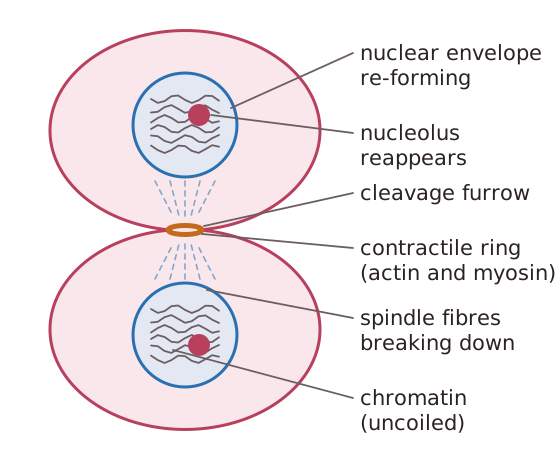
Telophase
Read the text
Read the text and highlight anything you think is important. When you go on, the text is hidden and you answer from memory.
Specification: AQA Biology (7401), AS-level, 3.2.2 All cells arise from other cells. Topic: The Cell Cycle.
Key terms in this lesson
- chromatin
- DNA loosely wound around histone proteins, found in the nucleus when the cell is not dividing.
- nucleolus
- A dense structure within the nucleus where ribosomal RNA is made and ribosomes are assembled.
- spindle fibres
- Protein fibres that extend across a dividing cell and attach to the centromeres of chromosomes, pulling them apart.
More in The Cell Cycle
- Mitosis
- Prophase
- Metaphase
- Anaphase
- Cytokinesis
- The Importance of Mitosis
- Cancer and the Control of Mitosis
- Treatment of Cancer
All 12 lessons in The Cell Cycle · All AQA AS-level Biology topics