 BRAINCAKE
Mitosis
Mitosis is important in growth, repair and asexual reproduction. Mitosis is the process where the nucleus of a cell divides into two daughter nuclei.
The two daughter nuclei are genetically identical to each other and the parent nucleus that gave rise to it.
There are four stages of mitosis:
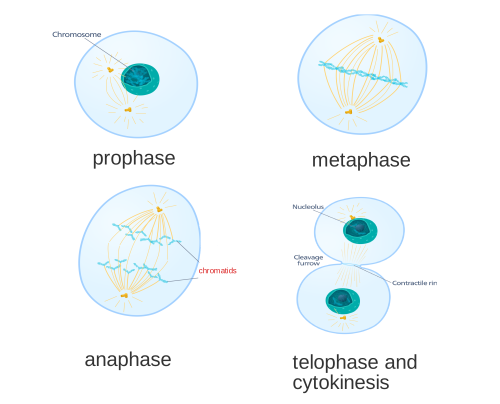
Sign in free to see the rest of this lesson, the R.E.C.I.P.E. recall steps and the quiz
BrainCake is free. Make an account in seconds and pick up where this page stops.
Key terms in this lesson
- ATP
- Adenosine triphosphate, a nucleotide that acts as the immediate energy source in cells, releasing energy when hydrolysed to ADP and phosphate.
- chromatin
- DNA loosely wound around histone proteins, found in the nucleus when the cell is not dividing.
- nucleolus
- A dense structure within the nucleus where ribosomal RNA is made and ribosomes are assembled.
- chromatid
- One of two identical copies of a chromosome, joined at the centromere, formed by DNA replication.
More in The Cell Cycle
- The Cell Cycle
- Prophase
- Metaphase
- Anaphase
- Telophase
- Cytokinesis
- The Importance of Mitosis
- Cancer and the Control of Mitosis
All 12 lessons in The Cell Cycle · All AQA AS-level Biology topics