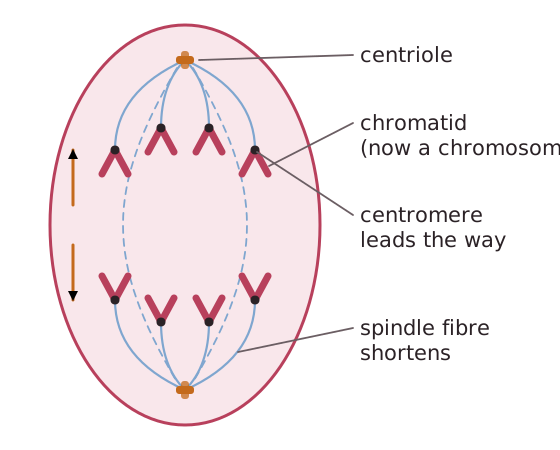
Anaphase is the stage of mitosis that follows metaphase. At the start of anaphase the centromere holding each pair of sister chromatids together divides.The spindle fibres attached to the centromeres shorten, pulling the sister chromatids apart. The chromatids move to opposite poles of the cell, centromere first, so they take on a V-shape as they are dragged through the cytoplasm.Once separated, each chromatid is now an individual chromosome. Each pole receives one copy of every chromosome, so the two new nuclei will be genetically identical to each other and to the parent cell.Moving the chromatids requires energy, which is supplied as ATP from respiration in the mitochondria. Other spindle fibres push the poles further apart, which stretches the cell.Anaphase ends when the two sets of chromosomes reach the poles.