Skip to content

Measuring Enzyme-Catalysed Reactions

Factors affecting the activity of an enzyme will be factors that influence the ability of the substrate to bind to the active site and form enzyme-substrate complexes.These include:
  • limiting factors such as substrate concentration and enzyme concentration.
  • inhibitors (competitive and non-competitive) which prevent the binding of the substrate to the active site.
  • any change affecting the environment that leads to a change in the shape of the active site of the enzyme such as temperature and pH.
The rate at which the product is formed or the rate at which the substrate disappears at any given temperature or pH, with or without inhibitor, can be experimentally determined.
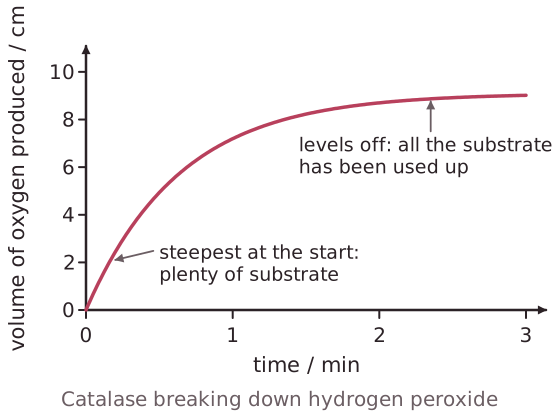
At first there is a lot of substrate so the frequency of collisions is a maximum.As the product is formed the frequency of collisions decreases and the rate of reaction decreases and the graph becomes less steep.The graph flattens once all the substrate has been used up.

Read the text

Read the text and highlight anything you think is important. When you go on, the text is hidden and you answer from memory.

Specification: AQA Biology (7401), AS-level, 3.1.4.2 Many proteins are enzymes. Topic: Enzymes.

Key terms in this lesson

active site
The region of an enzyme, formed by the tertiary structure, with a shape complementary to its substrate, where the substrate binds.
enzyme-substrate complex
The temporary structure formed when a substrate binds to the active site of an enzyme.

More in Enzymes

All 17 lessons in Enzymes · All AQA AS-level Biology topics