 BRAINCAKE
Effect of Temperature on Enzyme Action
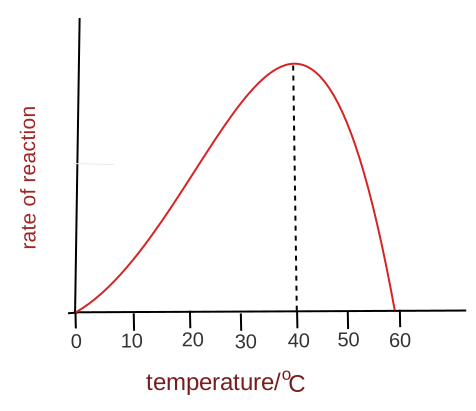
As the temperature is increased the kinetic energy of the molecules increases and the molecules move faster and collide more often and with more energy.
There are more frequent and more effective collisions so more enzyme-substrate complexes are formed in a given time.
At the optimum temperature, the rate of enzyme-substrate complex formation is a maximum.
Sign in free to see the rest of this lesson, the R.E.C.I.P.E. recall steps and the quiz
BrainCake is free. Make an account in seconds and pick up where this page stops.
Key terms in this lesson
- hydrogen bond
- A weak electrostatic attraction between a slightly positive hydrogen atom on one polar molecule and a slightly negative atom, such as oxygen or nitrogen, on another.
- active site
- The region of an enzyme, formed by the tertiary structure, with a shape complementary to its substrate, where the substrate binds.
- enzyme-substrate complex
- The temporary structure formed when a substrate binds to the active site of an enzyme.