 BRAINCAKE
Secondary Structure
Each peptide bond is the result of a condensation reaction where a water molecule is removed from a -COOH and an NH2 group to form a covalent bond.
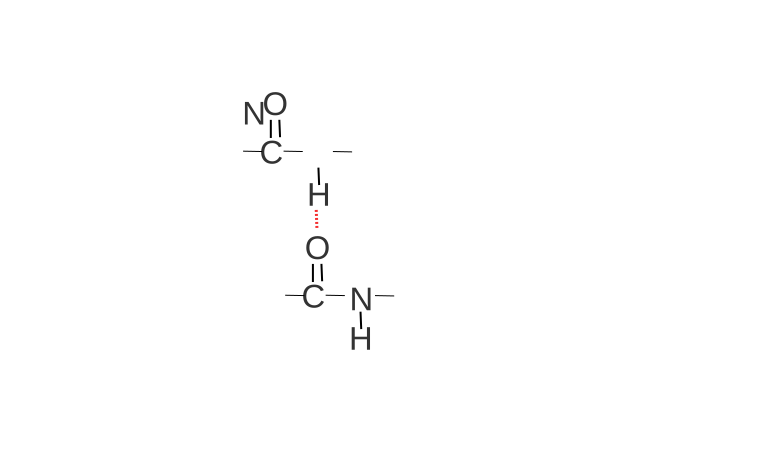
Each peptide bond is therefore a -CONH- group.
Sign in free to see the rest of this lesson, the R.E.C.I.P.E. recall steps and the quiz
BrainCake is free. Make an account in seconds and pick up where this page stops.
Key terms in this lesson
- covalent bond
- A strong chemical bond formed when a pair of electrons is shared between two atoms.
- hydrogen bond
- A weak electrostatic attraction between a slightly positive hydrogen atom on one polar molecule and a slightly negative atom, such as oxygen or nitrogen, on another.
- condensation reaction
- A reaction that joins two molecules together with a covalent bond, with the elimination of a water molecule.
More in Biological Molecules
- Test for Lipids
- Amino-Acids
- Peptide Bond Formation
- Primary Structure
- Tertiary Structure
- Quaternary Structure
- Test for Proteins
- Globular and Fibrous Proteins
All 29 lessons in Biological Molecules · All AQA AS-level Biology topics