 BRAINCAKE
Peptide Bond Formation
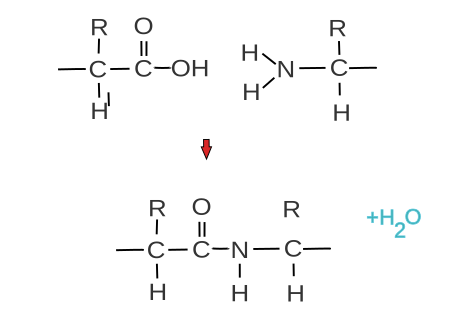
Amino acids join together by condensation reactions. The -OH from the carboxyl group of one amino acid combines with an -H from the amino group of another, and a molecule of water is removed.
The covalent bond that forms between the carbon of the carboxyl group and the nitrogen of the amino group is called a peptide bond, -CONH-. Two amino acids joined in this way form a dipeptide.
Sign in free to see the rest of this lesson, the R.E.C.I.P.E. recall steps and the quiz
BrainCake is free. Make an account in seconds and pick up where this page stops.
Key terms in this lesson
- condensation reaction
- A reaction that joins two molecules together with a covalent bond, with the elimination of a water molecule.
- hydrolysis
- The breaking of a covalent bond within a molecule using a water molecule.
More in Biological Molecules
- Phospholipids
- Properties of Phospholipids
- Test for Lipids
- Amino-Acids
- Primary Structure
- Secondary Structure
- Tertiary Structure
- Quaternary Structure
All 29 lessons in Biological Molecules · All AQA AS-level Biology topics