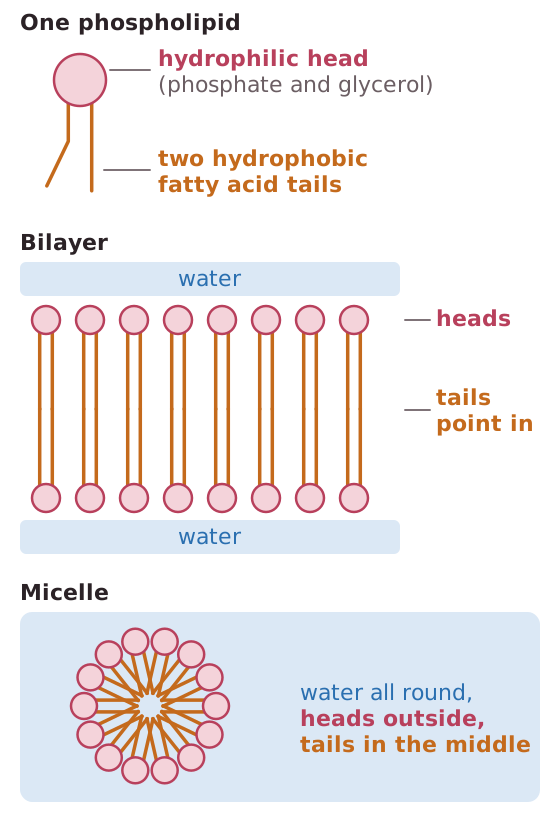
Phospholipids have a hydrophilic head and a hydrophobic tail.When placed in water the molecules align so that the hydrophilic heads are close to water molecules and the hydrophobic tails are as far away as possible from the water molecules.If phospholipids are put into an aqueous environment they form a bilayer with the hydrophobic tails oriented away from the water or form micelles.The plasma membrane is formed from a phospholipid bilayer. The lipids can combine with carbohydrate chains to form glycolipids on the cell surface. Glycolipids are important in cell recognition.
Properties of Phospholipids
Read the text
Read the text and highlight anything you think is important. When you go on, the text is hidden and you answer from memory.
Specification: AQA Biology (7401), AS-level, 3.1.3 Lipids. Topic: Biological Molecules.
Key terms in this lesson
- phospholipid
- A lipid in which one fatty acid is replaced by a phosphate group, giving a hydrophilic head and hydrophobic tails.
- micelle
- A tiny droplet formed from bile salts, monoglycerides and fatty acids, which aids the digestion and absorption of lipids.
More in Biological Molecules
- Roles of Lipids
- Triglycerides
- Properties of Triglycerides
- Phospholipids
- Test for Lipids
- Amino-Acids
- Peptide Bond Formation
- Primary Structure
All 29 lessons in Biological Molecules · All AQA AS-level Biology topics