Limiting factors can be classified by whether their effect depends on how crowded the population is.Density-dependent factors have a greater effect as population density increases. They are usually biotic:• competition for food, space and mates becomes more intense in a crowded population
• disease spreads more easily when individuals live close together
• predation: predators catch prey more easily when prey are abundant, and predator numbers may rise
• parasitism spreads more readily between hostsBecause their effect grows with density, density-dependent factors tend to regulate population size and keep it fluctuating around the carrying capacity.Density-independent factors affect a population to the same extent whatever its density. They are usually abiotic:• natural disasters such as floods, fires, volcanic eruptions and hurricanes
• extreme weather, such as a very cold winter or drought
• sudden changes in climate or pollution eventsThese can kill a large proportion of a population suddenly, whether the population is large or small, and can cause a population crash. They do not regulate population size.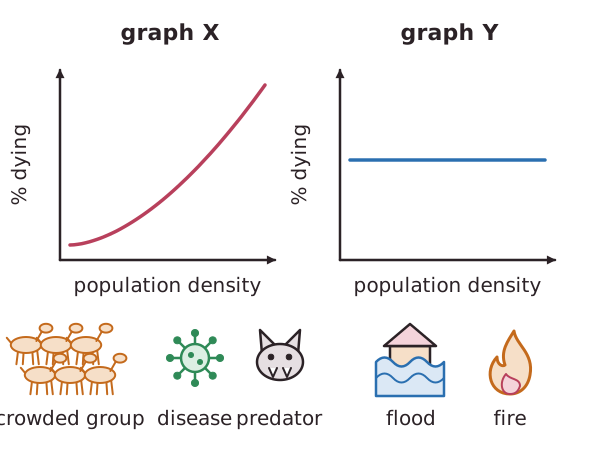 Example: if a hard frost kills 40% of a population of small birds, it kills 40% whether there are 100 birds or 1000 birds, so it is density-independent. If a disease kills 5% of a sparse population but 30% of a crowded one, it is density-dependent.
• disease spreads more easily when individuals live close together
• predation: predators catch prey more easily when prey are abundant, and predator numbers may rise
• parasitism spreads more readily between hostsBecause their effect grows with density, density-dependent factors tend to regulate population size and keep it fluctuating around the carrying capacity.Density-independent factors affect a population to the same extent whatever its density. They are usually abiotic:• natural disasters such as floods, fires, volcanic eruptions and hurricanes
• extreme weather, such as a very cold winter or drought
• sudden changes in climate or pollution eventsThese can kill a large proportion of a population suddenly, whether the population is large or small, and can cause a population crash. They do not regulate population size.
Example: if a hard frost kills 40% of a population of small birds, it kills 40% whether there are 100 birds or 1000 birds, so it is density-independent. If a disease kills 5% of a sparse population but 30% of a crowded one, it is density-dependent.