Quadrats are used to sample plants and slow-moving or sessile animals.A frame quadrat is a square frame (often 0.5 m × 0.5 m or 1 m × 1 m), often divided into 100 smaller squares. Abundance can be recorded as:• density: number of individuals per unit area (for plants that can be counted)
• percentage cover: percentage of the quadrat area covered by a species (for plants such as grass or moss where individuals are hard to count)
• frequency: the proportion of quadrats (or small squares) in which a species occurs
• an abundance scale such as ACFOR (abundant, common, frequent, occasional, rare), which is quick but subjective.A point quadrat is a frame holding a row of pins; each species touched by a pin is recorded. It is useful in dense vegetation.Transects are used to study how distribution changes across a habitat, for example from a shoreline inland or from open ground into woodland:• line transect: a tape is laid across the area and every species touching the line at regular intervals is recorded
• belt transect: quadrats are placed continuously along the line
• interrupted belt transect: quadrats are placed at regular intervals along the line, saving time over long distances.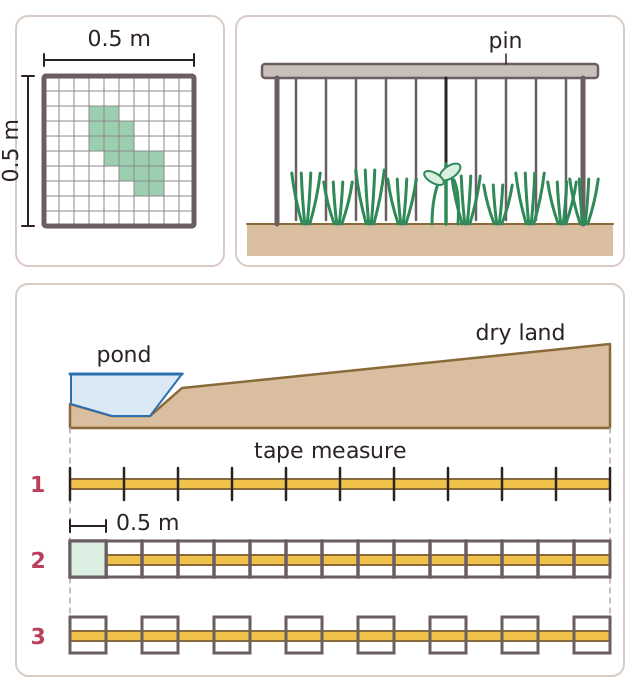 Worked example: 18 daisies are counted in a 0.5 m × 0.5 m quadrat. Area = 0.25 m2, so density = 18 ÷ 0.25 = 72 daisies per m2.
• percentage cover: percentage of the quadrat area covered by a species (for plants such as grass or moss where individuals are hard to count)
• frequency: the proportion of quadrats (or small squares) in which a species occurs
• an abundance scale such as ACFOR (abundant, common, frequent, occasional, rare), which is quick but subjective.A point quadrat is a frame holding a row of pins; each species touched by a pin is recorded. It is useful in dense vegetation.Transects are used to study how distribution changes across a habitat, for example from a shoreline inland or from open ground into woodland:• line transect: a tape is laid across the area and every species touching the line at regular intervals is recorded
• belt transect: quadrats are placed continuously along the line
• interrupted belt transect: quadrats are placed at regular intervals along the line, saving time over long distances.
Worked example: 18 daisies are counted in a 0.5 m × 0.5 m quadrat. Area = 0.25 m2, so density = 18 ÷ 0.25 = 72 daisies per m2.