A broth culture may contain millions of bacteria per cm3. Plated directly, the colonies would merge into a lawn and could not be counted. Serial dilution reduces the concentration in known steps until the colonies can be counted.Method (tenfold dilutions)
1. Put 9.0 cm3 of sterile water (or broth) into each of several sterile test tubes.
2. Using a sterile pipette, add 1.0 cm3 of the culture to the first tube and mix. This is a 10−1 (1 in 10) dilution.
3. With a fresh sterile pipette, transfer 1.0 cm3 from this tube to the next and mix, giving 10−2. Repeat to give 10−3, 10−4 and so on.
4. Spread a known volume (for example 0.1 cm3) from each dilution onto an agar plate, using aseptic technique, and incubate.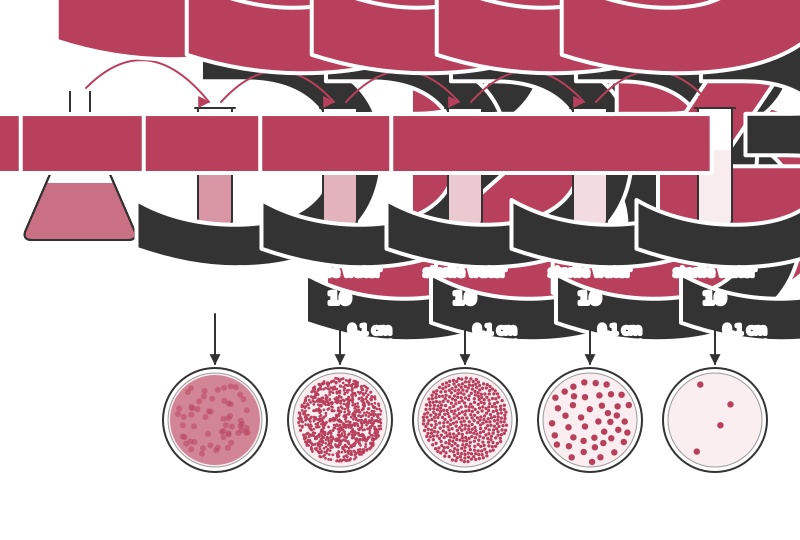
number of cells in original culture = number of colonies × dilution factor ÷ volume plated Worked example: 0.1 cm3 of the 10−4 dilution gave 45 colonies.
Cells per cm3 of the dilution = 45 ÷ 0.1 = 450.
Cells per cm3 of the original = 450 × 104 = 4.5 × 106 cm−3.This count only includes live cells, and it is an underestimate if two cells grew into one colony.
1. Put 9.0 cm3 of sterile water (or broth) into each of several sterile test tubes.
2. Using a sterile pipette, add 1.0 cm3 of the culture to the first tube and mix. This is a 10−1 (1 in 10) dilution.
3. With a fresh sterile pipette, transfer 1.0 cm3 from this tube to the next and mix, giving 10−2. Repeat to give 10−3, 10−4 and so on.
4. Spread a known volume (for example 0.1 cm3) from each dilution onto an agar plate, using aseptic technique, and incubate.
Cells per cm3 of the dilution = 45 ÷ 0.1 = 450.
Cells per cm3 of the original = 450 × 104 = 4.5 × 106 cm−3.This count only includes live cells, and it is an underestimate if two cells grew into one colony.