Aseptic technique is the set of procedures used to prevent contamination: unwanted microorganisms getting into a culture, and the culture escaping into the environment or onto people. Contamination would affect results and could allow pathogens to grow.Before starting
• Wash hands and disinfect the work surface.
• Sterilise media, Petri dishes and glassware in an autoclave (steam at 121 °C for about 15 minutes).
• Work near a lit Bunsen burner. The rising hot air (convection current) carries microorganisms away from the work area.During transfers
• Sterilise the wire inoculating loop by heating it in the Bunsen flame until it glows red hot, then let it cool before use, so it does not kill the culture.
• Flame the neck of culture bottles after removing the lid and before replacing it. The heat stops airborne microorganisms entering.
• Open lids for as short a time as possible and lift the Petri dish lid only slightly, at an angle, so microorganisms from the air cannot fall in.
• Hold bottle lids in the hand rather than putting them on the bench.After inoculating
• Secure the Petri dish lid with two short strips of tape, not sealed all the way round, so oxygen can still enter and anaerobic pathogens are not encouraged.
• Incubate plates upside down, so condensation does not drip onto the agar.
• After use, sterilise all cultures and equipment in an autoclave before disposal, and disinfect the bench again.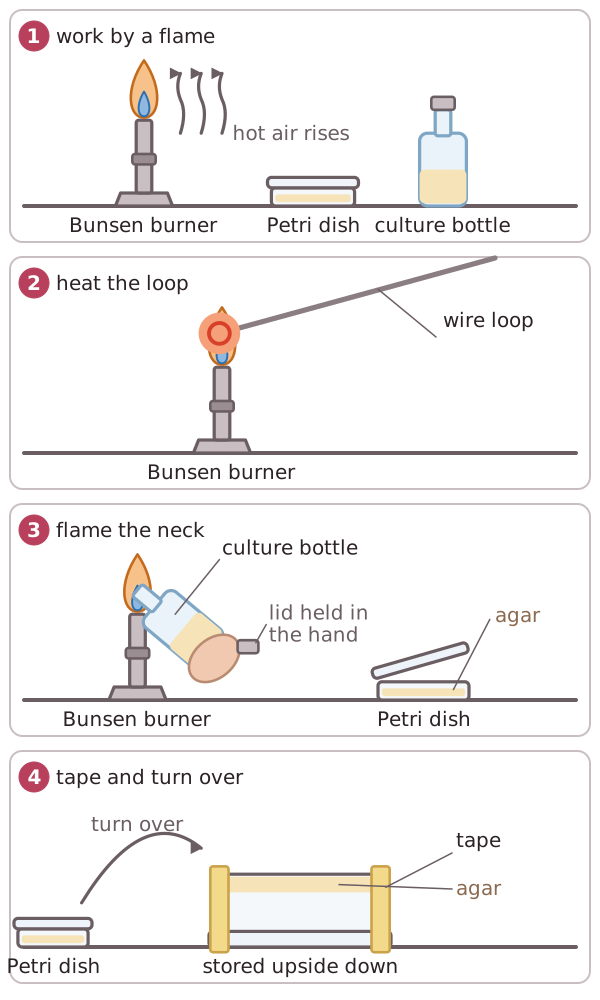
• Wash hands and disinfect the work surface.
• Sterilise media, Petri dishes and glassware in an autoclave (steam at 121 °C for about 15 minutes).
• Work near a lit Bunsen burner. The rising hot air (convection current) carries microorganisms away from the work area.During transfers
• Sterilise the wire inoculating loop by heating it in the Bunsen flame until it glows red hot, then let it cool before use, so it does not kill the culture.
• Flame the neck of culture bottles after removing the lid and before replacing it. The heat stops airborne microorganisms entering.
• Open lids for as short a time as possible and lift the Petri dish lid only slightly, at an angle, so microorganisms from the air cannot fall in.
• Hold bottle lids in the hand rather than putting them on the bench.After inoculating
• Secure the Petri dish lid with two short strips of tape, not sealed all the way round, so oxygen can still enter and anaerobic pathogens are not encouraged.
• Incubate plates upside down, so condensation does not drip onto the agar.
• After use, sterilise all cultures and equipment in an autoclave before disposal, and disinfect the bench again.