Stem rust spreads between wheat plants by wind-borne spores. Urediniospores are light and produced in enormous numbers, and they can be carried by wind for hundreds or even thousands of kilometres, so the disease can cross countries and seas. Spores can also be carried on clothing, tools and farm machinery.Infection follows a set sequence:
1. A urediniospore lands on a wheat stem or leaf.
2. It needs a film of free water, such as dew, for several hours to germinate, so infection is most likely after wet nights followed by warm days.
3. A germ tube grows over the surface until it reaches a stoma.
4. The tip swells to form an appressorium over the stoma, and an infection peg grows through the stomatal pore into the air spaces inside.
5. Hyphae grow between the host cells (intercellularly).
6. Hyphae push haustoria through the cell walls of host cells. Each haustorium is surrounded by the host's cell surface membrane, which is not broken, and absorbs sugars and amino acids from the living cell.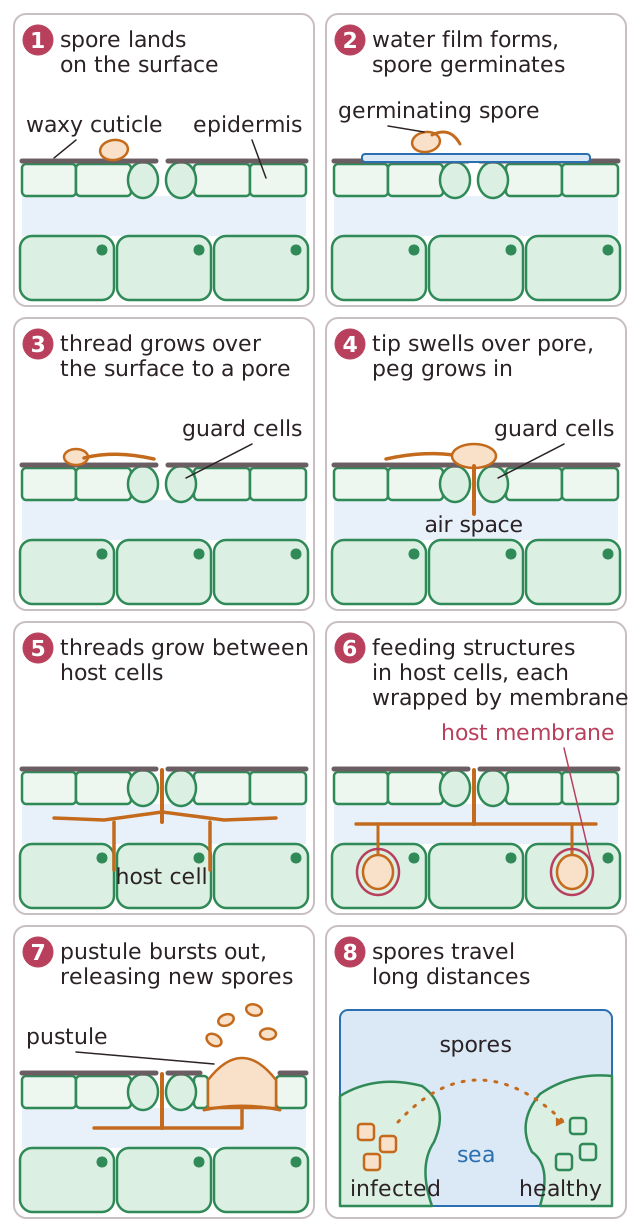 About 7 to 15 days after infection the mycelium forms a new pustule, which bursts through the epidermis and releases new urediniospores, starting the cycle again.Because the fungus enters through stomata rather than breaking through the surface, the waxy cuticle does not protect the plant. Keeping the host cells alive is essential for the fungus, because it is an obligate parasite.
1. A urediniospore lands on a wheat stem or leaf.
2. It needs a film of free water, such as dew, for several hours to germinate, so infection is most likely after wet nights followed by warm days.
3. A germ tube grows over the surface until it reaches a stoma.
4. The tip swells to form an appressorium over the stoma, and an infection peg grows through the stomatal pore into the air spaces inside.
5. Hyphae grow between the host cells (intercellularly).
6. Hyphae push haustoria through the cell walls of host cells. Each haustorium is surrounded by the host's cell surface membrane, which is not broken, and absorbs sugars and amino acids from the living cell.
About 7 to 15 days after infection the mycelium forms a new pustule, which bursts through the epidermis and releases new urediniospores, starting the cycle again.Because the fungus enters through stomata rather than breaking through the surface, the waxy cuticle does not protect the plant. Keeping the host cells alive is essential for the fungus, because it is an obligate parasite.