Puccinia graminis is the fungus that causes stem rust (black rust) of wheat. It also infects barley, oats and rye. It is an obligate parasite: it can only grow and reproduce on living host tissue.The fungus has a complex life cycle involving five types of spore and two different hosts:
• the primary host, a cereal such as wheat
• the alternate host, the barberry bush (Berberis).In summer, the fungus forms rust-coloured pustules on wheat stems and leaves. These release urediniospores, which are carried by wind to other wheat plants. Each pustule releases thousands of spores and a new generation of pustules can form every one to two weeks, so the disease spreads through a crop very rapidly. This repeating cycle on wheat alone is the stage that causes epidemics.Towards the end of the season, the pustules produce black, thick-walled teliospores, which survive the winter on crop stubble. In spring they germinate to form basidiospores, which infect barberry leaves. Sexual reproduction happens on barberry, and it produces aeciospores that are blown back onto wheat. Sexual reproduction creates genetic variation, producing new races of the fungus that may overcome resistance in wheat varieties.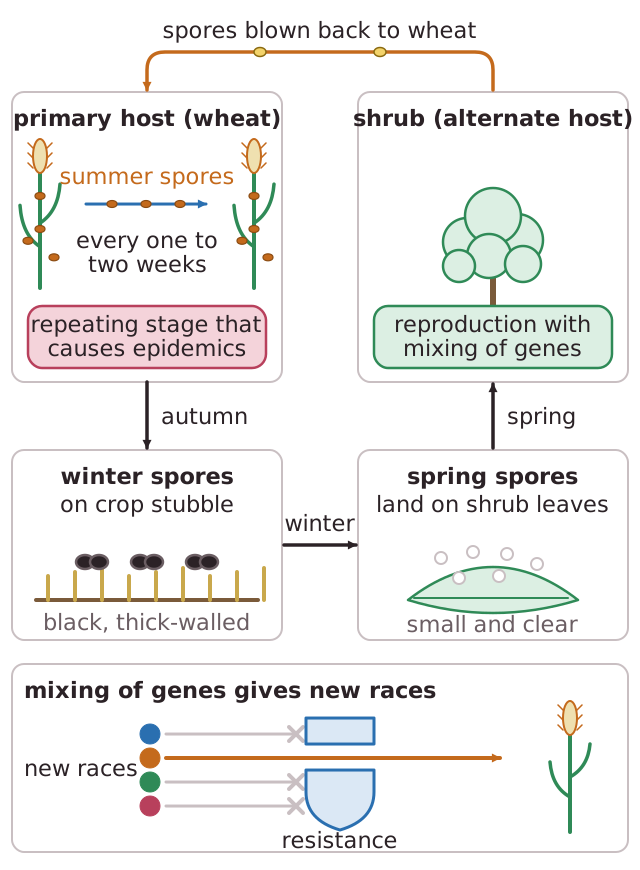 Stem rust has caused severe crop failures in the past. In 1999 a highly virulent race called Ug99 was found in Uganda. It overcame most of the resistance genes in wheat grown worldwide and has spread through Africa and into the Middle East.
• the primary host, a cereal such as wheat
• the alternate host, the barberry bush (Berberis).In summer, the fungus forms rust-coloured pustules on wheat stems and leaves. These release urediniospores, which are carried by wind to other wheat plants. Each pustule releases thousands of spores and a new generation of pustules can form every one to two weeks, so the disease spreads through a crop very rapidly. This repeating cycle on wheat alone is the stage that causes epidemics.Towards the end of the season, the pustules produce black, thick-walled teliospores, which survive the winter on crop stubble. In spring they germinate to form basidiospores, which infect barberry leaves. Sexual reproduction happens on barberry, and it produces aeciospores that are blown back onto wheat. Sexual reproduction creates genetic variation, producing new races of the fungus that may overcome resistance in wheat varieties.
Stem rust has caused severe crop failures in the past. In 1999 a highly virulent race called Ug99 was found in Uganda. It overcame most of the resistance genes in wheat grown worldwide and has spread through Africa and into the Middle East.