Some carbon is locked away for thousands to millions of years in long-term carbon sinks. These form when dead organic matter is not fully decomposed, or when carbon is built into rock.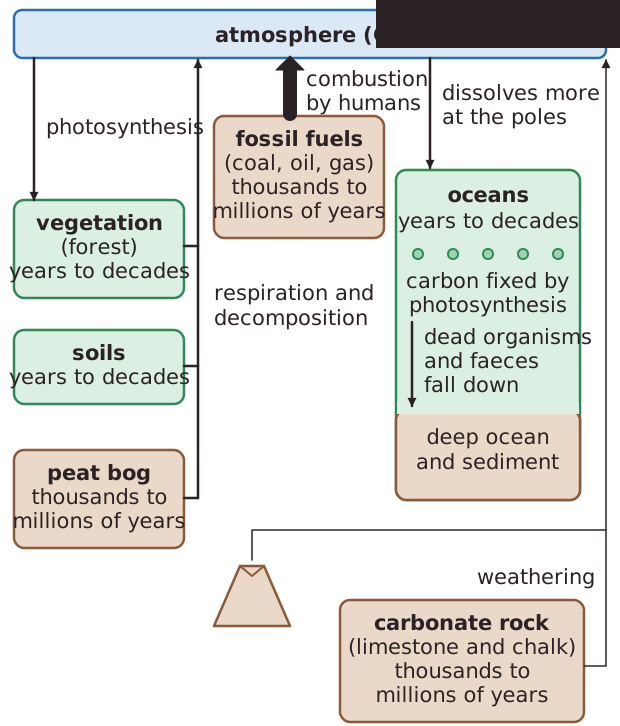 Peat forms in bogs where waterlogged, cold, acidic conditions keep oxygen out. Because conditions are anaerobic, saprobionts work very slowly, so partly decayed plant material, mainly sphagnum moss, builds up faster than it decomposes. Peatlands cover only about 3% of the Earth's land but hold more carbon than all the world's forests.Fossil fuels (coal, oil and natural gas) formed from organic matter buried under sediment millions of years ago. Heat and pressure over long periods turned it into hydrocarbons. Coal formed mainly from ancient swamp plants; oil and gas formed mainly from marine plankton.Carbonate rocks such as limestone and chalk form from the calcium carbonate (CaCO3) shells and skeletons of marine organisms such as corals, molluscs and plankton. When they die these sink to the seabed and are compressed over time. Carbonate rock is the largest carbon store on Earth.By natural processes carbon returns from these sinks only very slowly, through weathering of rock and volcanic eruptions. Draining a peat bog lets oxygen in, so decomposition speeds up and the bog becomes a source. Burning fossil fuels releases in decades carbon that took millions of years to lock away, which is faster than the other sinks can absorb it.