Lymphocytes are the white blood cells responsible for the specific immune response. Unlike phagocytes, each lymphocyte responds to only one antigen. They are small cells with a large nucleus that fills most of the cell.All lymphocytes are made from stem cells in the bone marrow. They then mature in one of two places:
• B lymphocytes (B cells) mature in the bone marrow
• T lymphocytes (T cells) move to the thymus and mature there.During maturation each lymphocyte develops its own receptor proteins in its cell surface membrane. The genes for these receptors are rearranged randomly in each cell, so millions of different receptor shapes are produced, each complementary to a different antigen. Lymphocytes whose receptors would bind to self antigens are destroyed, so only those that recognise non-self antigens survive.This means that, even before an infection, the body has a small number of lymphocytes able to recognise almost any antigen. When an antigen enters, only the lymphocytes with complementary receptors respond.Mature lymphocytes circulate in the blood and lymph and collect in the lymph nodes, spleen and tonsils, where they are likely to meet antigens. This is why lymph nodes swell during an infection.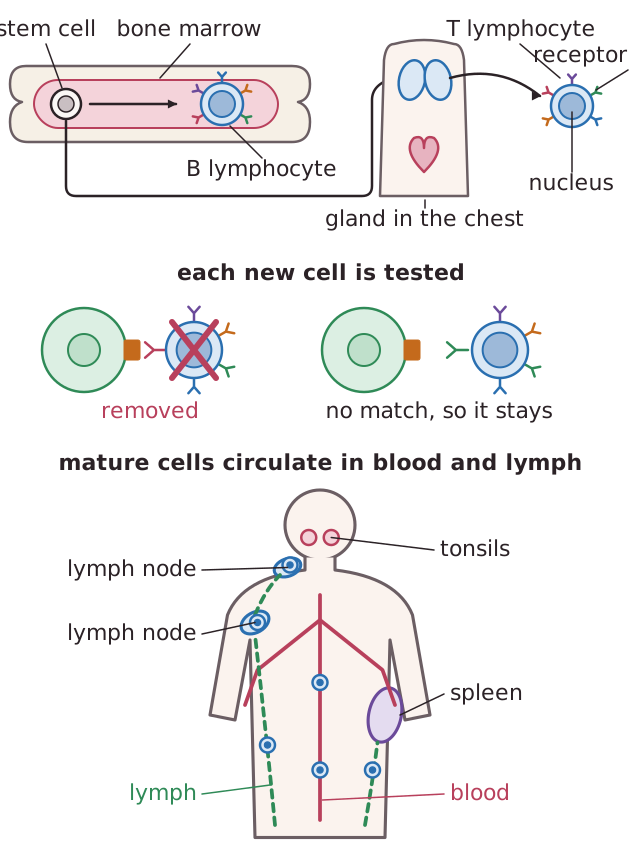 There are several types with different roles:
• B cells, which develop into plasma cells that secrete antibodies
• T helper cells, which coordinate the response
• T killer cells, which destroy infected body cells
• memory cells, which give long-term immunity.
• B lymphocytes (B cells) mature in the bone marrow
• T lymphocytes (T cells) move to the thymus and mature there.During maturation each lymphocyte develops its own receptor proteins in its cell surface membrane. The genes for these receptors are rearranged randomly in each cell, so millions of different receptor shapes are produced, each complementary to a different antigen. Lymphocytes whose receptors would bind to self antigens are destroyed, so only those that recognise non-self antigens survive.This means that, even before an infection, the body has a small number of lymphocytes able to recognise almost any antigen. When an antigen enters, only the lymphocytes with complementary receptors respond.Mature lymphocytes circulate in the blood and lymph and collect in the lymph nodes, spleen and tonsils, where they are likely to meet antigens. This is why lymph nodes swell during an infection.
There are several types with different roles:• B cells, which develop into plasma cells that secrete antibodies
• T helper cells, which coordinate the response
• T killer cells, which destroy infected body cells
• memory cells, which give long-term immunity.