 BRAINCAKE
Chloroplasts
Chloroplasts are the organelles in which photosynthesis takes place. They are found mainly in the palisade mesophyll cells of leaves, and are usually disc-shaped, about 2 to 10 µm across.
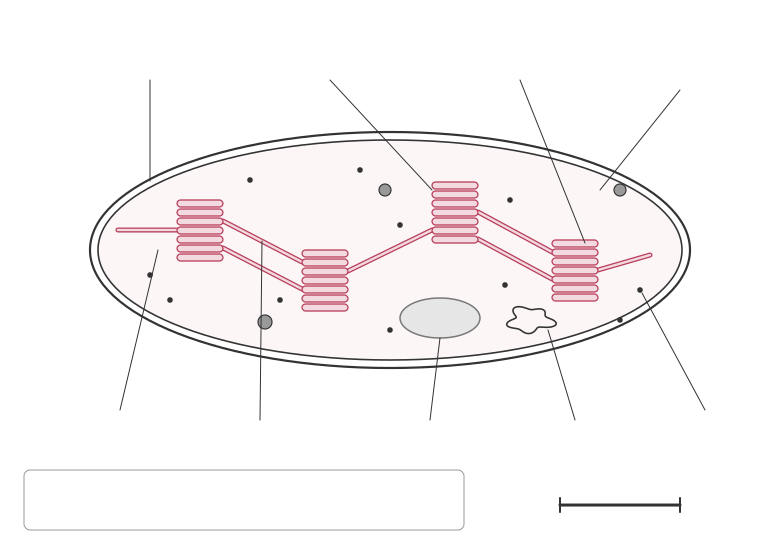
Structures and functions:
• Envelope: a double membrane that surrounds the chloroplast and controls what enters and leaves.
• Thylakoids: flattened membrane sacs. Their membranes hold the photosynthetic pigments (in photosystems), electron carriers and ATP synthase, so they are the site of the light-dependent reactions.
• Grana (singular granum): stacks of thylakoids, which give a very large surface area for absorbing light.
Sign in free to see the rest of this lesson, the R.E.C.I.P.E. recall steps and the quiz
BrainCake is free. Make an account in seconds and pick up where this page stops.
More in Photosynthesis
- Autotrophs and Heterotrophs
- The Process of Photosynthesis
- Chlorophyll
- Absorption Spectrum Chlorophyll
- Chromatography
- Photosystems
- The Light-Dependent Reactions
- Cyclic Photophosphorylation
All 20 lessons in Photosynthesis · All Edexcel A-level Biology topics