 BRAINCAKE
Absorption Spectrum Chlorophyll
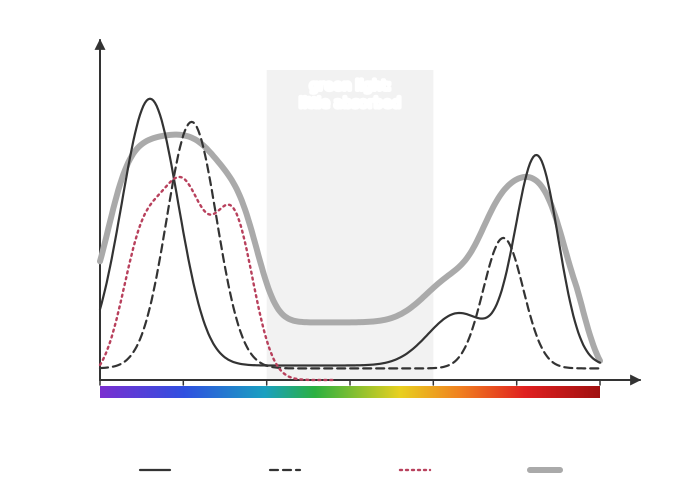
An absorption spectrum is a graph showing how much light a pigment absorbs at each wavelength. It is measured by passing light of different wavelengths through a pigment extract in a spectrophotometer (or a colorimeter with filters).
Key features:
• Chlorophyll a has two main peaks, in the blue (about 430 nm) and red (about 660 nm) parts of the spectrum.
• Chlorophyll b has peaks at slightly different wavelengths, closer together, extending absorption in the blue and orange-red.
• Carotenoids absorb mainly blue-violet light, from about 400 to 500 nm.
• Very little light is absorbed between about 500 and 560 nm, the green part of the spectrum.
Sign in free to see the rest of this lesson, the R.E.C.I.P.E. recall steps and the quiz
BrainCake is free. Make an account in seconds and pick up where this page stops.
More in Photosynthesis
- Autotrophs and Heterotrophs
- The Process of Photosynthesis
- Chloroplasts
- Chlorophyll
- Chromatography
- Photosystems
- The Light-Dependent Reactions
- Cyclic Photophosphorylation
All 20 lessons in Photosynthesis · All Edexcel A-level Biology topics