Repolarisation is the return of the membrane potential from its positive peak back towards the negative resting potential.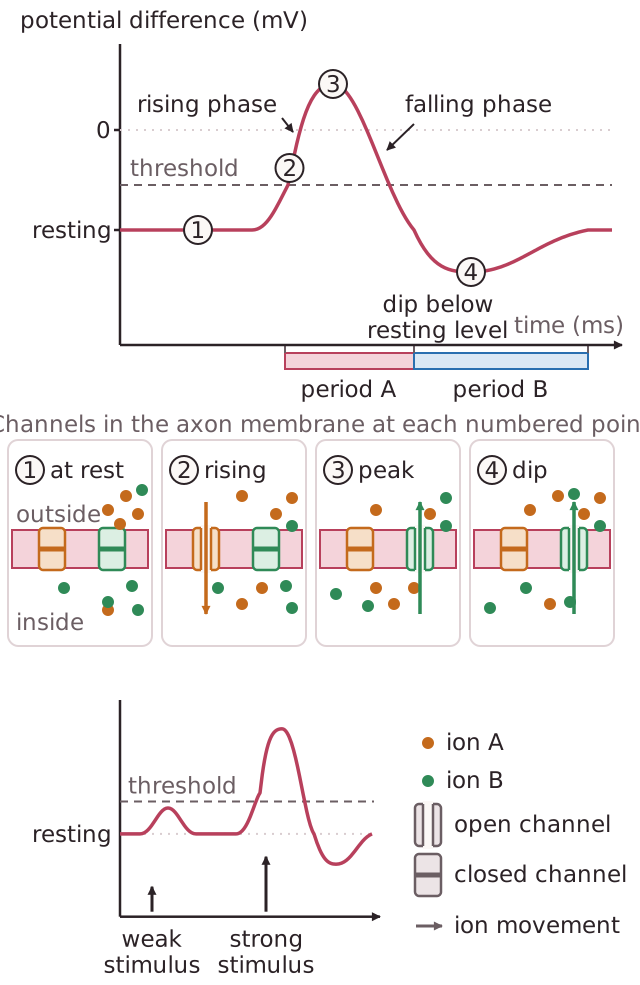 When the potential reaches about +40 mV, two things happen:• the voltage-gated sodium ion channels close (they become inactivated), so no more Na+ enters the axon
• voltage-gated potassium ion channels openThe inside of the axon has a high concentration of K+ and is now positively charged, so both the concentration gradient and the electrical gradient favour K+ leaving. K+ ions diffuse out of the axon. As positive charge leaves, the inside becomes less positive and then negative again.The voltage-gated K+ channels respond more slowly than the Na+ channels. This delay matters: the K+ channels only open fully once depolarisation has peaked, so they do not cancel out the rising phase of the action potential.Repolarisation does not depend on the sodium-potassium pump. It is caused by facilitated diffusion of K+ through channel proteins, which is why it takes only about 1 ms. The pump works continuously in the background and maintains the ion gradients over the longer term.While the Na+ channels are inactivated during repolarisation, they cannot be opened again by another stimulus. So another action potential cannot be generated during this time, which is part of the refractory period.On a graph of an action potential, repolarisation is the steep downward slope from the peak. It usually overshoots the resting potential, which is called hyperpolarisation.
When the potential reaches about +40 mV, two things happen:• the voltage-gated sodium ion channels close (they become inactivated), so no more Na+ enters the axon• voltage-gated potassium ion channels openThe inside of the axon has a high concentration of K+ and is now positively charged, so both the concentration gradient and the electrical gradient favour K+ leaving. K+ ions diffuse out of the axon. As positive charge leaves, the inside becomes less positive and then negative again.The voltage-gated K+ channels respond more slowly than the Na+ channels. This delay matters: the K+ channels only open fully once depolarisation has peaked, so they do not cancel out the rising phase of the action potential.Repolarisation does not depend on the sodium-potassium pump. It is caused by facilitated diffusion of K+ through channel proteins, which is why it takes only about 1 ms. The pump works continuously in the background and maintains the ion gradients over the longer term.While the Na+ channels are inactivated during repolarisation, they cannot be opened again by another stimulus. So another action potential cannot be generated during this time, which is part of the refractory period.On a graph of an action potential, repolarisation is the steep downward slope from the peak. It usually overshoots the resting potential, which is called hyperpolarisation.