Mendel's second law is the law of independent assortment. It states that the alleles of different genes segregate independently of each other during gamete formation. Which allele of one gene a gamete receives has no effect on which allele of another gene it receives.Mendel found this when he followed two characteristics at once, such as seed shape and seed colour. The explanation is meiosis. If two genes are on different (non-homologous) chromosomes, each homologous pair lines up on the equator in random orientation in metaphase I. The way one pair lines up does not affect how the other pair lines up.Worked example: a plant with the genotype RrYy has R and r on one pair of chromosomes and Y and y on a different pair. In metaphase I, R can end up with Y or with y, equally likely. So the plant makes four types of gamete in equal proportions:RY : Ry : rY : ry = 1 : 1 : 1 : 1 Each gamete type has a probability of ½ × ½ = ¼.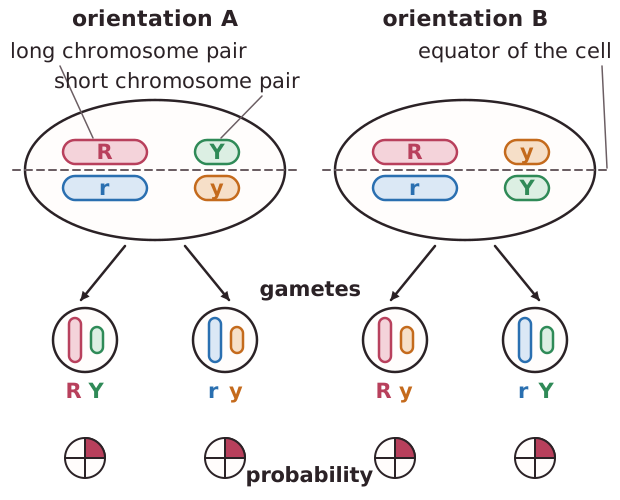 The law only applies to genes on different chromosomes (or genes very far apart on the same chromosome). Genes close together on the same chromosome tend to be inherited together because they do not assort independently; this is called linkage and is covered later in the topic.Independent assortment is a major source of genetic variation, as it produces new combinations of alleles in the gametes.