Alleles are codominant when both alleles are expressed in the phenotype of a heterozygote. Neither is dominant or recessive, so the heterozygote has a third, distinct phenotype that shows the effects of both alleles.Because neither allele is recessive, codominant alleles are written with the same capital letter for the gene and a superscript for each allele, for example CR and CW.Example: coat colour in shorthorn cattle. CRCR cattle are red, CWCW are white, and CRCW are roan: their coat has a mixture of red hairs and white hairs, because both alleles are expressed.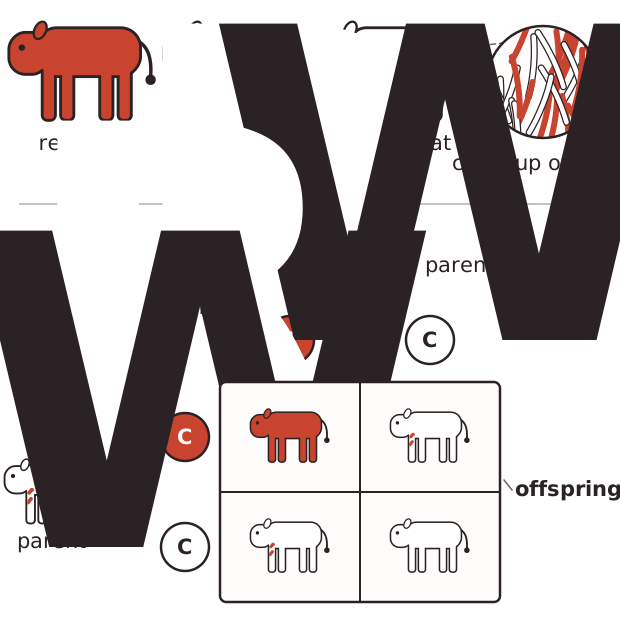 Worked example: two roan cattle are crossed.Parents: CRCW × CRCW
Gametes: CR, CW and CR, CW
Offspring: 1 CRCR : 2 CRCW : 1 CWCW
Phenotypes: 1 red : 2 roan : 1 whiteSo a cross between two heterozygotes gives a 1 : 2 : 1 phenotype ratio, not 3 : 1. Every genotype has its own phenotype, so the genotype can be read directly from the phenotype.Other examples: blood group AB (IAIB), where both A and B antigens are made, and sickle cell trait, where a person with the genotype HbAHbS makes both normal and sickle haemoglobin.
Worked example: two roan cattle are crossed.Parents: CRCW × CRCWGametes: CR, CW and CR, CW
Offspring: 1 CRCR : 2 CRCW : 1 CWCW
Phenotypes: 1 red : 2 roan : 1 whiteSo a cross between two heterozygotes gives a 1 : 2 : 1 phenotype ratio, not 3 : 1. Every genotype has its own phenotype, so the genotype can be read directly from the phenotype.Other examples: blood group AB (IAIB), where both A and B antigens are made, and sickle cell trait, where a person with the genotype HbAHbS makes both normal and sickle haemoglobin.