Several classic experiments show that cells become determined at a particular stage of development, and that this depends on gene expression rather than on genes being lost.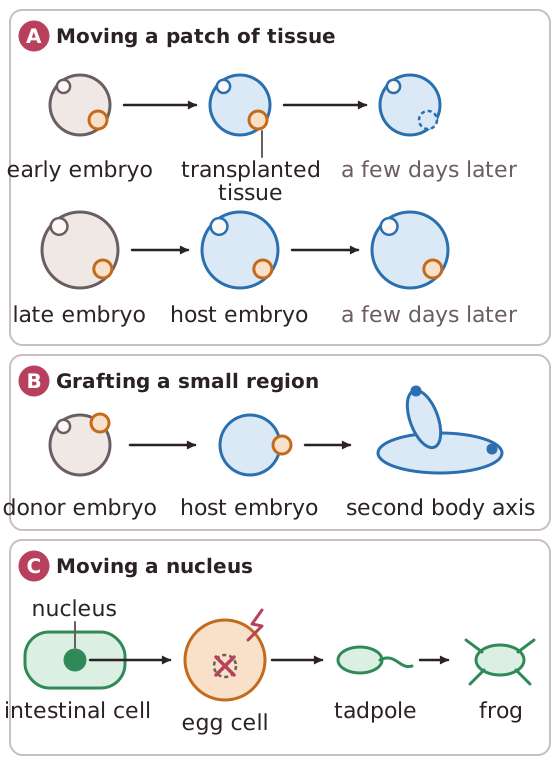 Transplantation experiments in amphibian embryos
Early in the 20th century, Hans Spemann transplanted small pieces of tissue between newt embryos at the gastrula stage.
• Tissue from an early gastrula that would normally have become nervous tissue was moved to a region that normally forms skin. It developed into skin, matching its new position. The cells were not yet determined.
• The same experiment using a late gastrula gave a different result: the transplanted tissue developed into nervous tissue, according to its origin. The cells had become determined between the early and late gastrula stages.The organiser
Spemann and Hilde Mangold transplanted a small region of one early embryo, the dorsal lip of the blastopore, into another embryo. The host developed a second body axis, including a second nervous system, formed partly from the host's own cells. This showed that some cells release signals that induce neighbouring cells to become determined.Nuclear transfer
John Gurdon took the nucleus from a fully differentiated intestinal cell of a tadpole and placed it into a frog egg cell whose own nucleus had been destroyed. Some of these eggs developed into tadpoles and even adult frogs. This showed that:
• a differentiated cell still contains all the genes needed to make a whole organism
• determination and differentiation happen because genes are switched off, not because they are lost
• the egg's cytoplasm can switch these genes back on.This work led to the cloning of mammals and to induced pluripotent stem cells.
Transplantation experiments in amphibian embryosEarly in the 20th century, Hans Spemann transplanted small pieces of tissue between newt embryos at the gastrula stage.
• Tissue from an early gastrula that would normally have become nervous tissue was moved to a region that normally forms skin. It developed into skin, matching its new position. The cells were not yet determined.
• The same experiment using a late gastrula gave a different result: the transplanted tissue developed into nervous tissue, according to its origin. The cells had become determined between the early and late gastrula stages.The organiser
Spemann and Hilde Mangold transplanted a small region of one early embryo, the dorsal lip of the blastopore, into another embryo. The host developed a second body axis, including a second nervous system, formed partly from the host's own cells. This showed that some cells release signals that induce neighbouring cells to become determined.Nuclear transfer
John Gurdon took the nucleus from a fully differentiated intestinal cell of a tadpole and placed it into a frog egg cell whose own nucleus had been destroyed. Some of these eggs developed into tadpoles and even adult frogs. This showed that:
• a differentiated cell still contains all the genes needed to make a whole organism
• determination and differentiation happen because genes are switched off, not because they are lost
• the egg's cytoplasm can switch these genes back on.This work led to the cloning of mammals and to induced pluripotent stem cells.