Determination is the process by which a cell becomes committed to developing into a particular type of cell. It happens before the cell shows any visible signs of specialisation. Differentiation comes afterwards, when the cell develops the structures and proteins of its final cell type.A determined cell may look exactly like the cells around it, but its fate is already fixed. If a determined cell is moved to a different part of the embryo, it still develops into the cell type it was committed to, not the type normally found in its new position.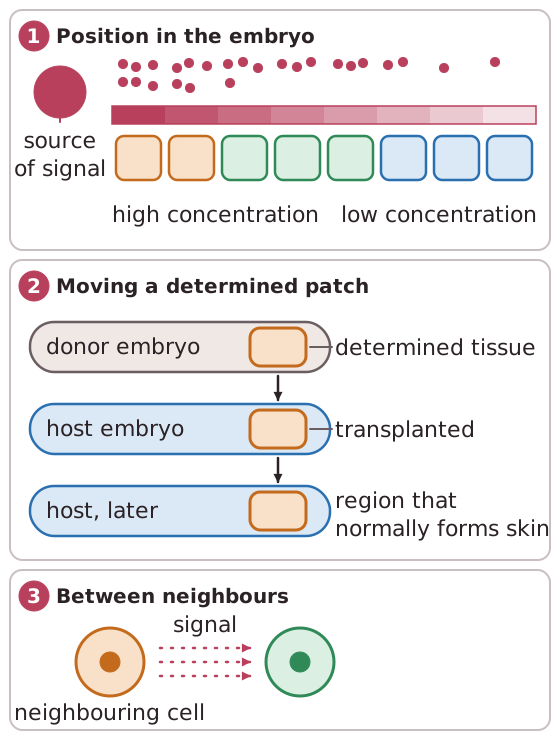 What determines a cell's fate?
• Position in the embryo: cells receive different signals depending on where they are. Chemical signals called morphogens are released from particular regions and diffuse through the tissue, forming a concentration gradient. Cells exposed to a high concentration switch on different genes from cells exposed to a low concentration.
• Signals from neighbouring cells: cells release chemicals that act on the cells next to them and switch on particular genes. This is called induction.
• Inherited cytoplasm: when a cell divides, the daughter cells may receive different mRNAs and proteins from the parent cell's cytoplasm.These signals activate transcription factors, which switch on sets of genes that commit the cell to a particular pathway. Epigenetic changes, such as DNA methylation and histone modification, then lock this pattern of gene expression in place. Because the marks are copied during mitosis, the cell and its descendants stay determined.As development continues, cells become determined to follow narrower and narrower pathways, and their potency decreases.
What determines a cell's fate?• Position in the embryo: cells receive different signals depending on where they are. Chemical signals called morphogens are released from particular regions and diffuse through the tissue, forming a concentration gradient. Cells exposed to a high concentration switch on different genes from cells exposed to a low concentration.
• Signals from neighbouring cells: cells release chemicals that act on the cells next to them and switch on particular genes. This is called induction.
• Inherited cytoplasm: when a cell divides, the daughter cells may receive different mRNAs and proteins from the parent cell's cytoplasm.These signals activate transcription factors, which switch on sets of genes that commit the cell to a particular pathway. Epigenetic changes, such as DNA methylation and histone modification, then lock this pattern of gene expression in place. Because the marks are copied during mitosis, the cell and its descendants stay determined.As development continues, cells become determined to follow narrower and narrower pathways, and their potency decreases.