Long day plants flower when the days are long and the nights are shorter than a critical length. In the UK they usually flower in late spring and summer. Examples include spinach, radish and red clover.It is really the length of the night, not the day, that matters.How phytochrome controls floweringIn long day plants, Pfr promotes flowering.- In summer the days are long, so a lot of Pfr is produced, and the nights are short, so there is little time for Pfr to convert back to Pr. Pfr stays high, the leaves produce florigen and the plant flowers.
- In winter the nights are long, so most Pfr reverts to Pr and the level of Pfr is too low for flowering.Night-break experimentsA long day plant kept on short days (long nights) does not flower. If the long night is interrupted by a brief flash of red light, Pr is converted to Pfr, the Pfr level stays high and the plant flowers, even though the days are short. If the red flash is immediately followed by a flash of far-red light, the Pfr is converted back to Pr and the plant does not flower.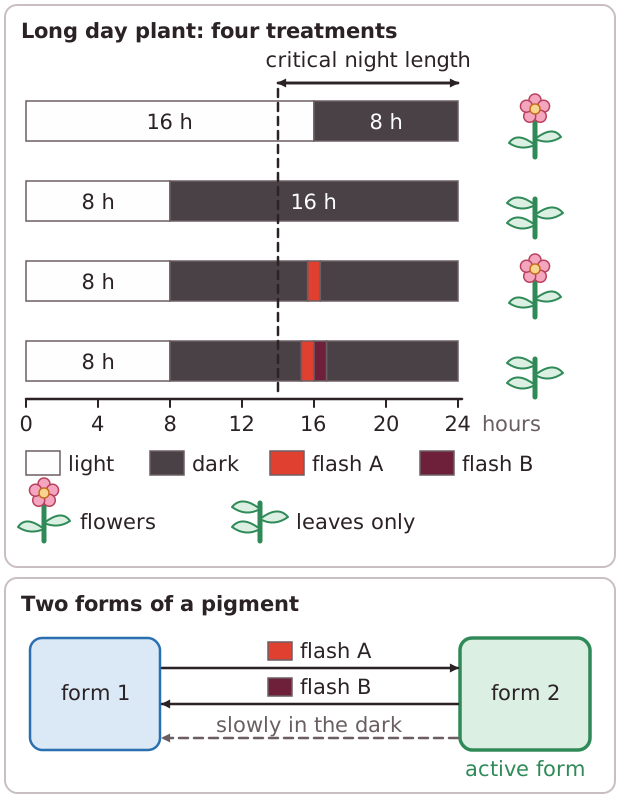 Worked exampleA long day plant has a critical night length of 10 hours. On a cycle of 16 hours light and 8 hours dark, the night is shorter than 10 hours, so it flowers. On 12 hours light and 12 hours dark, the night is longer than 10 hours, so it does not flower.
- In winter the nights are long, so most Pfr reverts to Pr and the level of Pfr is too low for flowering.Night-break experimentsA long day plant kept on short days (long nights) does not flower. If the long night is interrupted by a brief flash of red light, Pr is converted to Pfr, the Pfr level stays high and the plant flowers, even though the days are short. If the red flash is immediately followed by a flash of far-red light, the Pfr is converted back to Pr and the plant does not flower.
Worked exampleA long day plant has a critical night length of 10 hours. On a cycle of 16 hours light and 8 hours dark, the night is shorter than 10 hours, so it flowers. On 12 hours light and 12 hours dark, the night is longer than 10 hours, so it does not flower.