The mammalian nervous system is organised structurally into the central nervous system (CNS) and the peripheral nervous system (PNS). The CNS consists of the brain and spinal cord and the PNS all the neurones that connect to the CNS (sensory and motor neurones).Neurones originate from either the brain or the spinal cord.The spinal cord is a column of nervous tissue that runs along the back. It is protected by the vertebrae, 33 individual bones that interlock with each other to form the spinal or vertebral column.Pairs of nerves emerge from the spinal column at intervals.
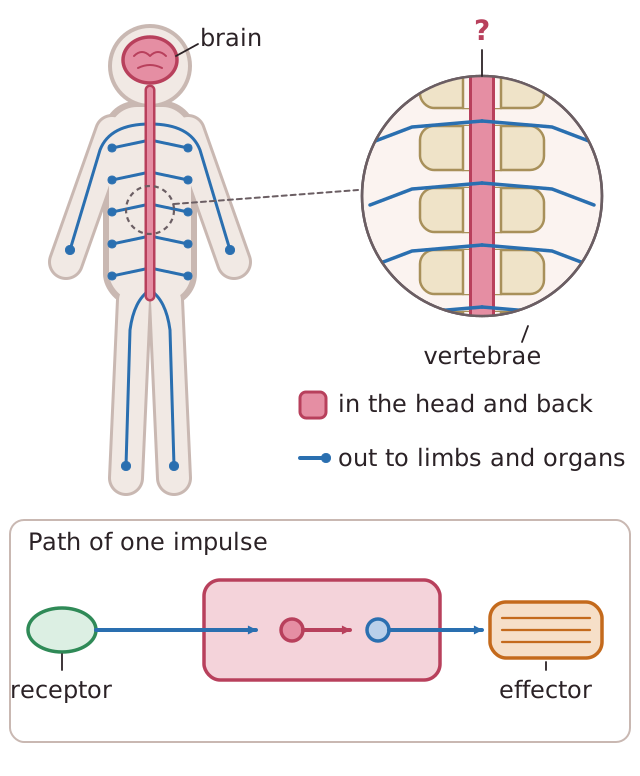
Structural Organisation of the Nervous System
Read the text
Read the text and highlight anything you think is important. When you go on, the text is hidden and you answer from memory.
Specification: AQA Biology (7402), A-level, 3.6.1.1 Survival and response and 3.6.2.1 Nerve impulses. Topic: Neuronal Communication.
More in Neuronal Communication
- Neurotransmitters
- Transmission of Impulse across Synapse
- The Role of Synapses
- Summation
- Functional Organisation of the Nervous System
- The Autonomic Nervous System
- Comparison of Neurones
- Receptors in the Eye - Rod Cells
All 38 lessons in Neuronal Communication · All AQA A-level Biology topics