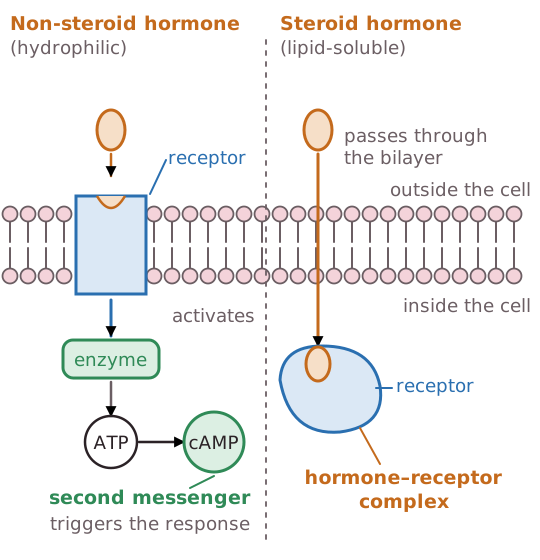
Hormones are chemical messengers that carry information from one part of the body to another. Hormones are secreted into the blood in response to nerve impulses, other hormones or a change in the concentration of substance such as blood glucose. Hormones diffuse all over the body, bind to specific receptors on target cells in target organs and stimulate the cells to produce a response.Steroid hormones are lipid-soluble. They pass through the phospholipid bilayer and bind to receptors in the cell forming hormone-receptor complexes. Non-steroid hormones are hydrophilic. They bind to specific receptors on the cell surface membrane of the target cell. This triggers a cascade of reactions involving other chemicals called second messengers.