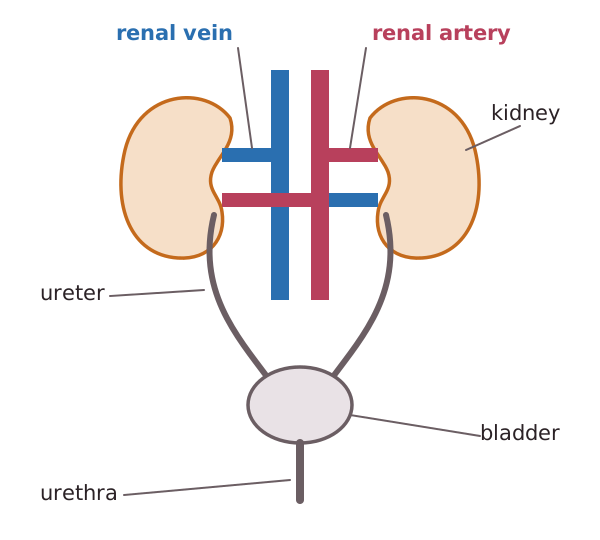
The kidneys are a pair of red-brown organs attached to the back of the abdominal cavity. They play a role in osmoregulation - regulation of water balance - and the excretion of nitrogenous waste such as urea.The kidney filters blood from the renal artery at a rate of 180dm3 a day. Blood is returned to the heart via the renal vein. The filtrate is collected by the collecting ducts and removed from the kidneys through the ureters and stored in the bladder. Urine passes out of the body through the urethra.
The Kidneys
Read the text
Read the text and highlight anything you think is important. When you go on, the text is hidden and you answer from memory.
Specification: AQA Biology (7402), A-level, 3.6.4.3 Control of blood water potential. Topic: Homeostasis.
Key terms in this lesson
- allele
- One of two or more alternative versions of a gene, occupying the same locus on homologous chromosomes.
- polymerase chain reaction
- A technique for rapidly amplifying small amounts of DNA in vitro, using repeated cycles of denaturation, primer annealing and extension by a heat-stable DNA polymerase.
- dna hybridisation
- The binding of a single strand of DNA, or RNA, to another strand with a complementary base sequence, forming a double-stranded hybrid.
More in Homeostasis
- Carbohydrate Metabolism in the Liver
- Transamination and Deamination
- Detoxification
- Production of Bile Salts, Bile Pigments and Cholesterol
- Structure of the Kidney
- Nephrons
- Bowman's Capsule
- Glomerulus
All 33 lessons in Homeostasis · All AQA A-level Biology topics