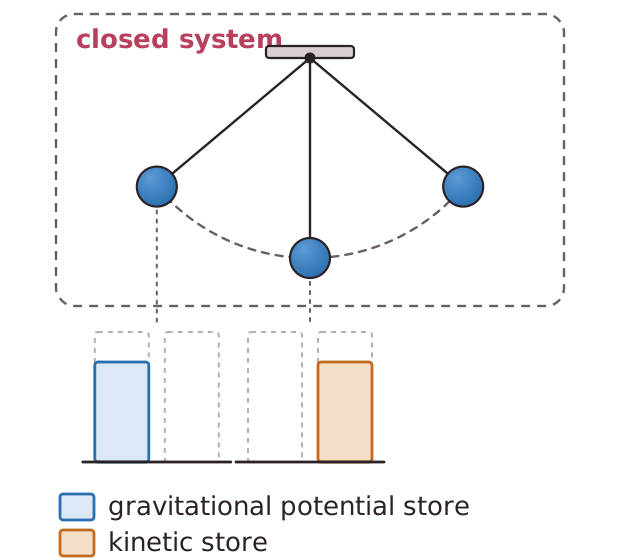
A closed system is a system where no energy enters or leaves. When anything changes inside it, energy is transferred between the stores, but energy is never created or destroyed. This is the principle of conservation of energy.
This means that in a closed system there is no net change to the total energy. The total energy before a change is equal to the total energy after the change, so the total energy stays the same, even though the energy may be shared between the stores in a different way.
Example: a pendulum has 8 J in its gravitational potential store at the top of its swing. If none is lost, then at the bottom the kinetic store holds 8 J. If some energy is dissipated to the thermal store of the air, the kinetic store holds less than 8 J, but the total of all the stores is still 8 J.
Example: a bouncing ball comes to rest. Its kinetic energy has been transferred to the thermal store of the ball and its surroundings, but the total energy is conserved.