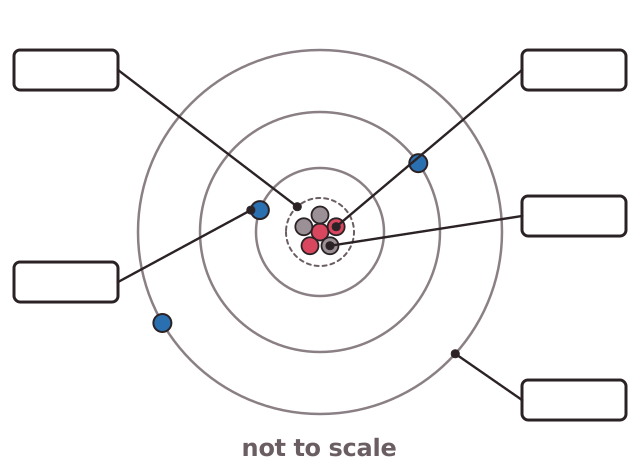
Every atom has a tiny nucleus at its centre. The nucleus contains two types of particle, protons and neutrons. Electrons move around the outside of the nucleus, a very long way out compared with the size of the nucleus.
The three particles are compared using relative mass and relative charge. A proton has a relative mass of 1 and a relative charge of +1. A neutron has a relative mass of 1 and a relative charge of 0, so it is neutral. An electron has a relative charge of -1 and a mass so small that it is about 1/2000 of the mass of a proton, so we say its mass is very small, much smaller than that of a proton or neutron.
An atom has the same number of protons as electrons. The +1 charges cancel the -1 charges, so an atom has an overall charge of zero.