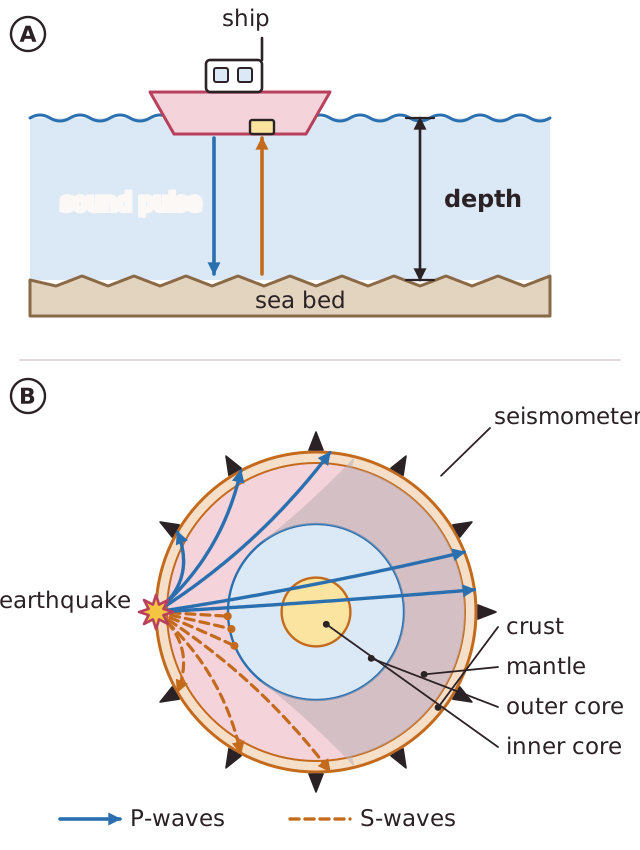
Waves in solids and liquids differ in velocity, absorption and reflection. These differences let us detect and explore structures that are hidden from direct view.
Ultrasound is sound with a frequency higher than the upper limit of human hearing, so above 20 kHz. When ultrasound meets a boundary between two different media, part of it is reflected. A detector measures the time taken for the reflections to arrive, and the distance to the boundary is found from the speed of the wave and this time. Because the pulse travels to the boundary and back, distance = speed × time / 2. This is used for medical imaging, such as scanning an unborn baby, and for industrial imaging, such as finding cracks inside metal.
Echo sounding works in the same way. A ship sends high frequency sound pulses down through the water and times the echo. For example, if the speed of sound in water is 1500 m/s and the echo returns after 0.4 s, the depth is 1500 × 0.4 / 2 = 300 m. Echo sounding also detects objects in deep water.
Seismic waves are produced by earthquakes. P-waves are longitudinal and can travel through both solids and liquids, at different speeds. S-waves are transverse and cannot travel through a liquid. Seismometers around the world detect these waves. S-waves are not detected on the far side of the Earth from an earthquake, which is evidence that part of the Earth's core is liquid. Changes in the speed and path of P-waves help to show the size of the core. The study of seismic waves gave new evidence about parts of the Earth that cannot be seen directly.