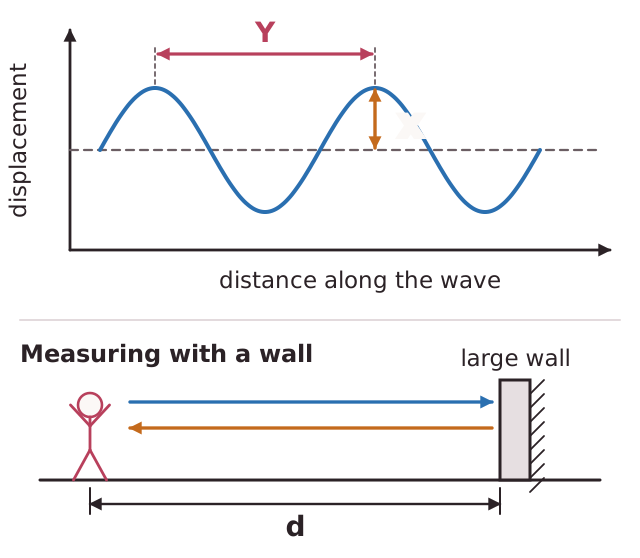
Wave motion is described using a few quantities. The amplitude is the maximum displacement of a point on the wave from its undisturbed position. The wavelength is the distance from a point on one wave to the equivalent point on the adjacent wave, for example from crest to crest. The frequency is the number of waves passing a point each second, measured in hertz (Hz). The period is the time taken for one wave to pass, and period = 1 / frequency, or T = 1 / f, with T in seconds and f in hertz. A wave of frequency 50 Hz has a period of 1 / 50 = 0.02 s.
The wave speed is the speed at which energy is transferred through the medium. All waves obey the wave equation: wave speed = frequency × wavelength, or v = f λ, with v in metres per second (m/s), f in hertz and λ in metres. A wave of frequency 10 Hz and wavelength 0.2 m has a speed of 10 × 0.2 = 2 m/s.
To measure the speed of sound in air, stand a measured distance d from a large wall, make a sharp sound and time the echo with a stopwatch. The sound travels a total distance of 2d, so speed = 2d divided by the time. Repeat and take an average. To measure the speed of ripples, use a ripple tank with a stroboscope to make the pattern appear still. Measure the distance across several wavelengths with a ruler and divide to find one wavelength, count the waves passing a point in a known time to find the frequency, then use v = f λ (required practical 8).
Physics only: when a sound wave passes from one medium into another, its frequency stays the same. Its speed changes, so by the wave equation its wavelength changes too. Sound travels faster in a solid than in air, so its wavelength increases when it enters a solid.