When a wave meets the boundary between two different materials, it can be reflected, absorbed or transmitted, and often more than one of these happens at once. A reflected wave bounces back into the first material. An absorbed wave transfers its energy to the energy stores of the material. A transmitted wave carries on through the second material, and its speed and direction may change.
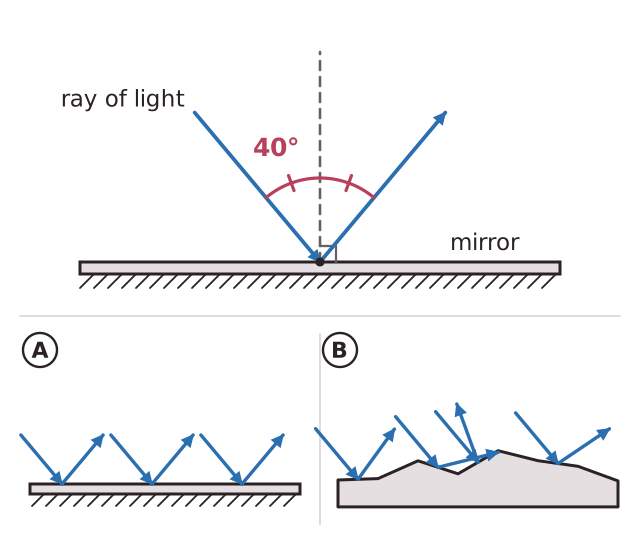
For reflection, the angle of incidence equals the angle of reflection. These angles are measured between the ray and the normal, which is a line drawn at 90° to the surface where the ray hits it. To construct a ray diagram, draw the surface, draw the normal at the point where the ray hits, draw the incident ray, measure the angle of incidence with a protractor, then draw the reflected ray on the other side of the normal at the same angle.
The type of surface matters. A smooth, flat surface such as a mirror reflects parallel rays in the same direction, so a clear image forms. A rough surface has a normal pointing in a different direction at each point, so parallel rays are reflected in many directions and are scattered. Shiny surfaces reflect most of the light, while matt black surfaces absorb most of it.
In required practical 9, a ray box and slit give a thin ray of light. Shine it at different surfaces, draw the normal, mark the paths of the incident and reflected rays and measure each angle with a protractor. The type of surface is the independent variable and the angle of reflection is the dependent variable. For refraction, shine the ray into a transparent block such as glass and measure the angle of refraction. The ray bends towards the normal as it enters the block.